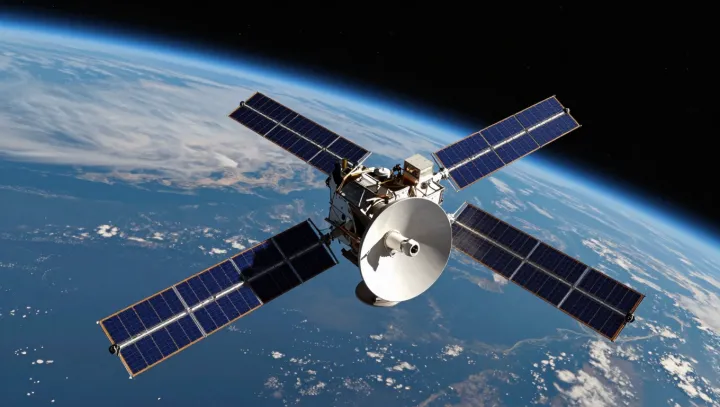
Darkness is no shutdown command. When a satellite passes into Earth's shadow, its solar panels stop generating electricity, but a charged battery keeps selected systems running until sunlight returns. The apparent simplicity hides a hard bargain: every watt used in darkness must first be collected, stored and protected against the strains of repeated charging.
Sunlight alone is not enough. Solar cells use the photovoltaic effect to convert light into electricity, supplying onboard equipment and charging batteries during illuminated portions of an orbit. Lithium-ion batteries are common, but their capacity and temperature limits shape how much work a spacecraft can do in eclipse. Power controllers regulate charging and distribute electricity; operators can also schedule demanding tasks for sunlit periods. Nothing comes for free. Larger panels and batteries add mass, which raises launch costs and can constrain a mission's design.
A strong signal need not mean a powerful transmitter. Antenna gain concentrates radio energy in a chosen direction, much as a reflector concentrates light, allowing more of the transmitted power to reach a distant receiver. The signal still spreads with distance, and accurate pointing matters: a narrow beam that misses its target wastes its advantage. Ground stations compensate with large antennas and sensitive receivers, while error-correcting codes help recover information from noisy transmissions. There is a tradeoff. Lower data rates can make weak signals easier to decode, but they leave less capacity for images and measurements. Against the dark curve of Earth, the satellite's dish holds its aim.