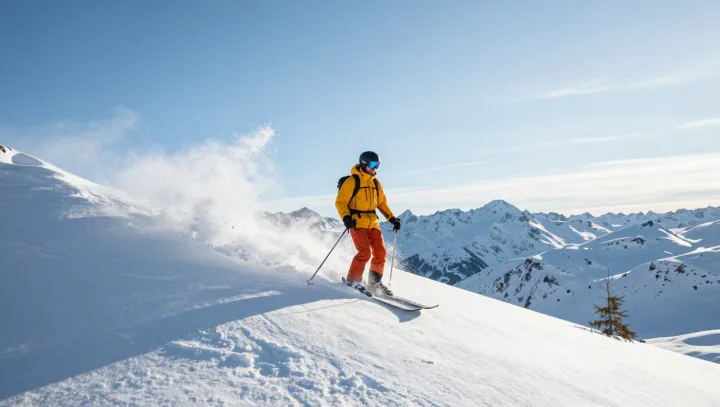
An avalanche can begin far from the skier who triggers it. Distance offers no guarantee. Beneath an apparently quiet expanse of snow, a buried weak layer can fracture under a skier's weight, sending a failure through connected terrain until a slab breaks loose on a slope the skier never entered.
The snowpack is less like a pile than a structure under strain. Its weak layer may consist of fragile crystals buried beneath a cohesive slab, which can transmit stress across considerable distances. When that weak layer collapses, fracture propagation can carry the failure outward, including uphill, if the layers remain connected. A steep slope may then release as a slab avalanche, pulled downhill by gravity. A hollow collapse sound, sometimes called a whumpf, is a warning sign of instability. Silence proves nothing.
The safest route demands a wider view than the track beneath the skis. A skier on gentle ground may still be exposed to a connected slope above or to snow running out below it. Check the local avalanche forecast, identify avalanche terrain and its runout zones, and choose conservative routes when unstable layers are suspected. Carry a transceiver, shovel and probe, and travel with partners trained to use them; rescue equipment cannot prevent a slide. The mountain's surface may look still, while its hidden structure waits for a load.