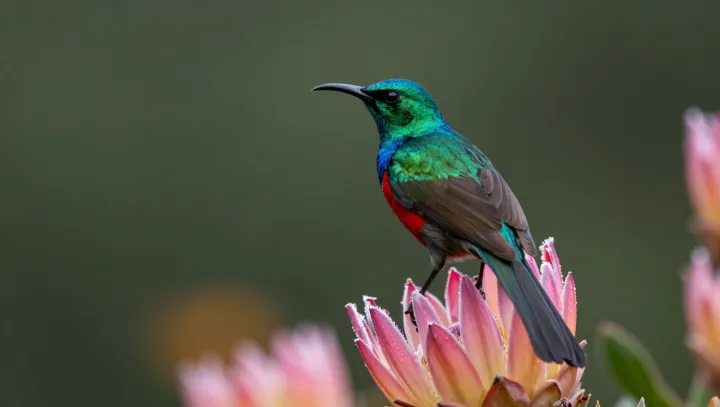
The southern double-collared sunbird does not drink through its bill like a straw. Its real feeding instrument is the tongue, whose brushlike tip reaches into flowers and collects nectar before returning it to the mouth. The distinction matters. A curved bill helps position the tongue; it is not a sealed drinking tube.
A brush makes more sense than a straw for gathering nectar from the small spaces inside a flower. The tongue extends beyond the bill, bringing its fringed tip into contact with the liquid. Capillary action, the movement of liquid through narrow spaces, can help draw nectar between fine structures; adhesion also helps liquid cling to surfaces. As the tongue retracts, nectar comes with it. That is a different process from suction, which relies on a pressure difference to pull liquid through a channel. The bill guides the tongue toward the flower's supply, while the tongue does the collecting.
The bird's equipment is best understood as a partnership, not a single tool. The slender, curved bill gives access to flowers that might be difficult to reach with a short, blunt mouth, while the long tongue makes contact with nectar inside. Flower shape and nectar depth still matter: a feeding position that works for one blossom may not suit another. The brush does not need to empty every flower to pay for the visit; nectar supplies sugars that fuel the bird's activity. What looks like a simple sip is a sequence of placement, contact and withdrawal. At the flower's opening, the bill frames the action without doing the drinking.