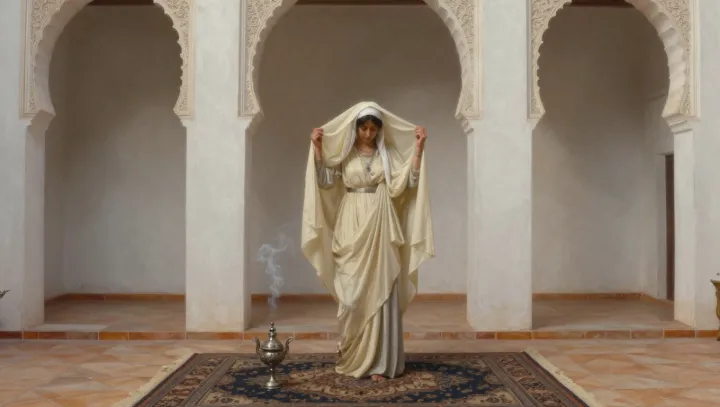
Luxury begins with an unlikely animal substance in John Singer Sargent's Smoke of Ambergris. A woman in pale robes bends over a burner, drawing its rising fumes toward her clothes. The whale is nowhere visible. Instead, Sargent makes the scent's imagined journey, from the sea to a perfumed interior, seem almost effortless.
The material behind the image is less ethereal than the painting suggests. Ambergris forms in the digestive system of some sperm whales, apparently around indigestible material such as squid beaks. Its prized scent develops as it ages and is exposed to air and seawater; oxidation transforms compounds including ambrein into aromatic substances. Perfumers have valued aged ambergris for its scent and its ability to help other fragrances last. Sargent shows none of that labor. What remains is smoke, fabric and an air of costly privacy.
The painting's restraint makes its promise persuasive. Its pale palette draws the eye across folds of cloth to the thin plume, while the woman's lowered face gives the act an absorbed, ceremonial quality. The title supplies a rare ingredient that viewers cannot actually smell or verify in the burner. The scene also belongs to the tradition of Orientalism, in which European artists presented imagined or selectively observed scenes from North Africa and the Middle East to audiences fascinated by distant customs. That framing matters: ritual here is as much an artistic construction as a record of practice. Between the hidden animal and the visible smoke lies the price of the illusion.