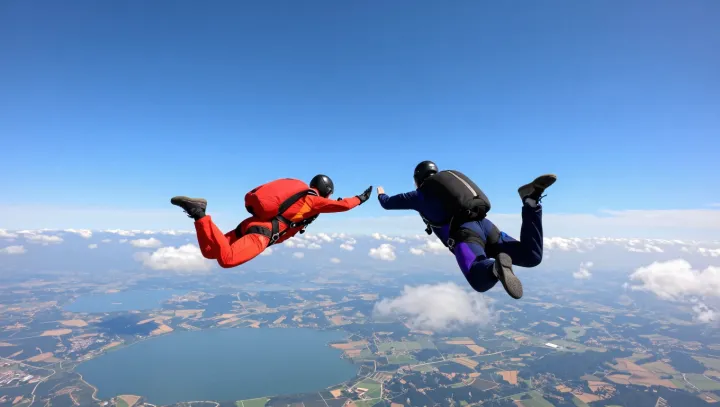
Gravity is not the whole story. Above the clouds, two skydivers can fall in the same direction and still draw closer, because the air rushing past their bodies supplies forces that need not point straight down. Their shared descent is the setting for a quieter contest: how each body meets the wind.
The useful distinction is between falling and steering. In freefall, a skydiver moves through air and experiences a relative wind from the opposite direction. By changing body position, the skydiver changes the aerodynamic forces acting on the body. Drag resists motion through the air; lift acts perpendicular to the relative wind. Tilt the body, and those forces can acquire a horizontal component. The result is sideways acceleration. Two skydivers can angle their bodies to move toward each other, even as gravity continues to pull both downward. They do not need to cancel gravity to close the gap.
Control, though, is more demanding than the picture suggests. A change in posture can alter descent speed as well as horizontal motion, so approaching another person also means managing the difference in altitude between them. Airflow, body position and separation keep changing; experienced skydivers make adjustments while maintaining awareness of one another. Parachute deployment then changes the forces dramatically, increasing drag and slowing descent. Before that moment, against the broad stillness of the clouds, the distance between two falling bodies can narrow without either escaping the pull below.