Spiral arms are not fixed strings of stars, and that distinction saves them from a seemingly inevitable fate. In a spiral galaxy, stars closer to the center generally orbit faster than those farther out. If an arm were made of the same stars throughout its life, differential rotation would wind it ever tighter.
The elegant answer is that a pattern can endure while its ingredients move. In density wave theory, regions of greater density travel through the galactic disk; stars and gas pass in and out rather than remaining permanently attached to an arm. Gas compressed in these regions can form new stars, including massive, luminous ones that make the arms conspicuous. The distinction matters. The speed of the pattern need not match the orbital speed of the material passing through it.
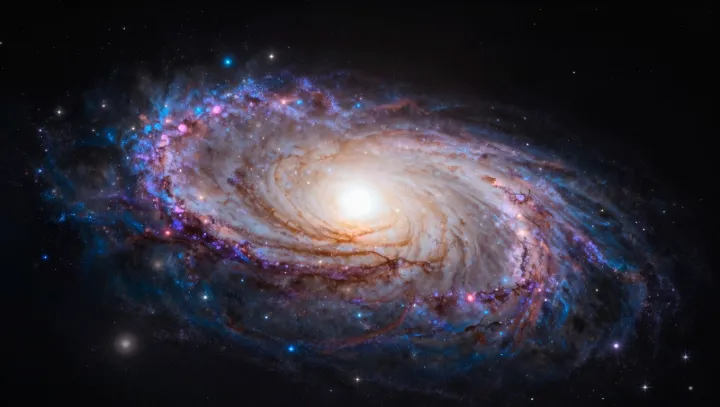
No single explanation has conquered every galaxy. Some simulations suggest that spiral arms can be temporary structures that form, fade and reappear, shaped by gravity within the disk or by encounters with neighboring galaxies. Bars across galactic centers can also influence the arrangement of arms. An illustration, with its bright center and sweeping lanes of stars, gas and dust, captures a shape but conceals the restless motion beneath it. The stars keep moving; the shape may outlast them.