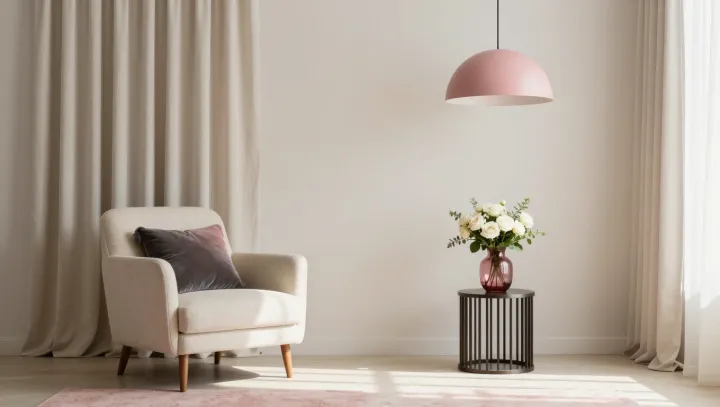
White roses are never quite white on their own. In a pink glass vase, their petals can look creamy beneath a warm lamp or crisp beside a window filled with cool daylight. The flowers have not changed. The light reaching them, and the colors reflected by the room around them, have.
The most useful decorating tool here is not another accessory but color temperature, a measure of how warm or cool a light source appears. A warm bulb can lend petals a golden cast; cooler daylight can make them seem bluer. Spectral reflectance also matters: petals reflect some wavelengths more than others, so their appearance depends on which wavelengths the light supplies. Bulbs with good color rendering make subtle differences easier to see. Pink glass can tint light passing through it, while the vase and nearby upholstery can also reflect color onto the flowers.
Placement is the simplest experiment. Set the vase near a window for a fresher, cooler impression, then try it beside a warm lamp for a softer mood; check both positions when the room is actually in use. Keep pale fabrics nearby if you want the roses to read cleanly, or let blush cushions pick up the vase's color. Green stems and leaves add contrast without demanding another ornament. Move the flowers away from strong direct sun and heat to help them last. In the evening, the same petals may seem to hold the room's remaining warmth.