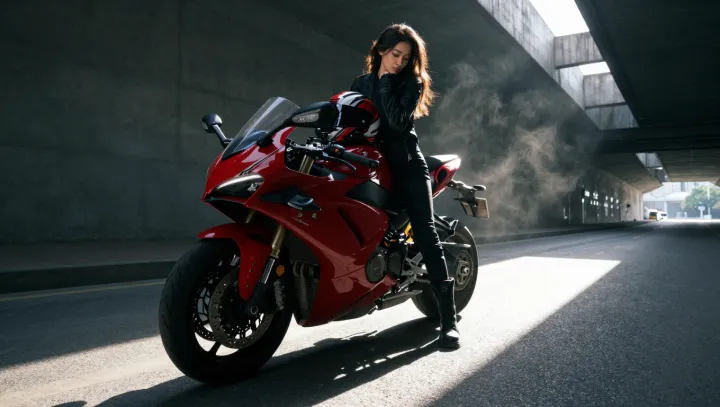
A sport motorcycle's wide rear tire is a bargain with a cost: better support for acceleration can come at the expense of easy steering. The red machine wears that bargain visibly. Its broad rubber must handle engine torque while still allowing the motorcycle to lean into a turn.
Width alone does not manufacture grip. The contact patch, where rubber meets pavement, changes shape with tire construction, pressure and load; a wider tire does not necessarily have a larger patch. But its shape and construction can help distribute forces and manage heat under hard acceleration, while a rounded profile provides usable rubber as the motorcycle leans. Compound and temperature matter too. A tire that cannot maintain traction will spin rather than turn more engine torque into forward motion.
The price is felt at the handlebars. A wider profile can require more lean for a given cornering path because the contact patch shifts farther from the motorcycle's centerline, and a heavier wheel and tire can increase rotational inertia, resisting changes in direction. Steering geometry, tire profile and suspension settings also shape the result, so width alone cannot predict how a motorcycle will handle. More rubber is not always better. Manufacturers choose a size that suits the engine and chassis rather than simply fitting the widest tire available. On the red motorcycle, the rear tire promises force; the curve ahead asks what that promise costs.