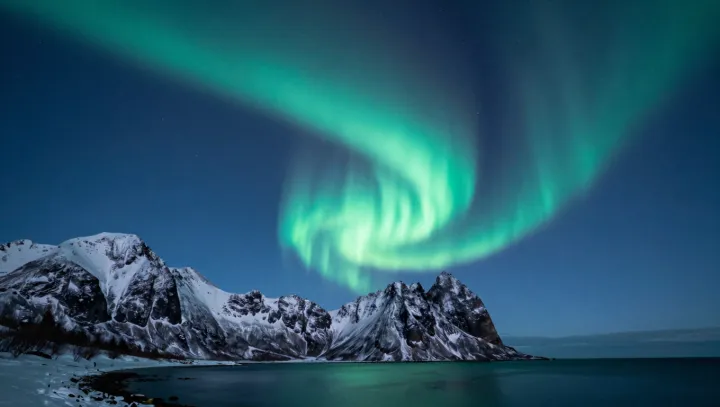
The northern lights owe their colors less to different gases than to the room oxygen has to glow. The distinction is altitude. High above Earth, oxygen can shine red; lower down, the same element more often produces green, because crowded air interrupts one form of light before it can emerge.
The display begins with a chain of events powered by the Sun, but the particles that strike the atmosphere are largely drawn from Earth's own magnetic environment. Solar wind disturbs the magnetosphere, directing charged particles, especially electrons, toward the polar regions. There they collide with atoms and molecules, transferring energy through excitation. The atmosphere answers in color. As excited particles return to lower energy states, they release photons; nitrogen, for example, can contribute blue and purple light.
Oxygen's red glow is the more fragile performance. Its excited atoms can take roughly two minutes to emit a red photon, whereas the green emission typically takes less than a second. At lower altitudes, frequent collisions with other particles often remove the energy before red light can escape, a process called collisional quenching. Higher up, the air is thinner, giving red emission enough time to appear, although oxygen is also less abundant there. Green auroras commonly occur around 100 to 150 kilometers above Earth; red auroras are often seen above 200 kilometers. In the dark, a faint red veil hangs over the brighter green.