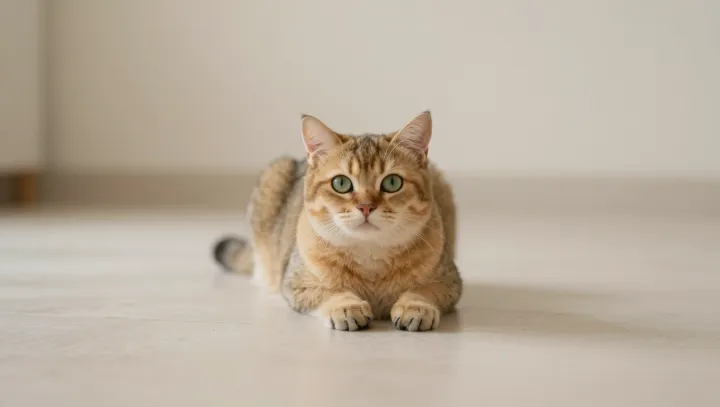
A falling cat turns without stealing a single scrap of angular momentum. The trick is not a loophole. By bending its spine and moving its legs, the animal can rotate its front and rear in opposite directions, changing its orientation while the total angular momentum of its body remains approximately constant.
The arrangement is more subtle than a simple twist. With its front legs tucked in and its rear legs extended, the cat reduces the moment of inertia of its front half while increasing that of its rear, so the two halves turn through different angles as they counter-rotate. Then the cat switches positions. Its front legs extend, its rear legs tuck in, and the process reverses. The rotations need not cancel in orientation, even though their angular momenta balance. Repeated movements can bring the paws beneath the body without requiring the tail to act as a propeller.
The landing, though, is no guarantee. The righting reflex depends on information from the inner ear and vision, and a cat needs enough time and space to complete its movements before impact. Gravity pulls the animal downward; it does not supply the twisting torque needed to explain the turn. Air resistance can exert forces and torques, but the central maneuver works without relying on them. The cat bends, turns and unfolds. For a moment, a body obeying the strictest accounting seems to have negotiated its own terms with the air.