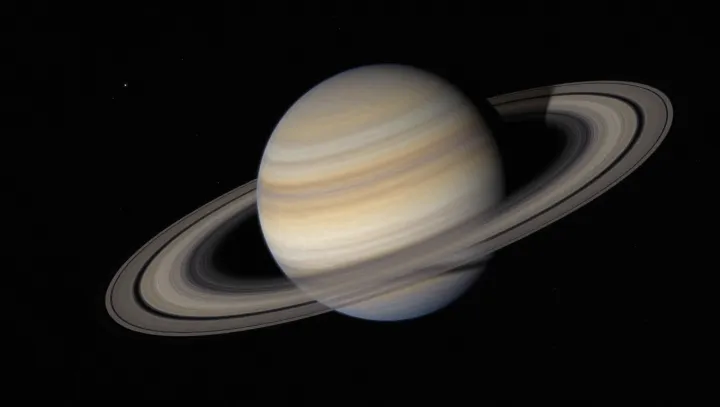
Saturn's rings are less like solid hoops than a vast, restless sheet of ice. They spread across hundreds of thousands of kilometers, yet much of the main ring system is only about ten meters thick. The contrast is extreme. Its explanation lies not in stillness but in countless collisions.
The material is deceptively ordinary. Water ice makes up most of the rings, with smaller amounts of rocky material and dust mixed in; individual pieces range from grains smaller than sand to objects as large as houses. Each follows its own orbit around Saturn, and nearby particles travel at different speeds. Encounters are unavoidable. When particles collide, some of their kinetic energy becomes heat or goes into deformation and fragmentation, reducing the random motions that would otherwise carry them farther above and below the ring plane.
Thinness, however, is not the same as perfect order. Saturn's gravity keeps particles in orbit, while their mutual gravity and the pull of nearby moons can stir them, creating waves, clumps and local variations in thickness. Collisions continually counter some of that stirring: the process is called collisional damping. No single particle holds the disk together, and no rigid surface keeps it flat. The rings persist through a negotiation between orbital motion, gravity and impact. Seen from afar, the result looks almost impossibly serene.