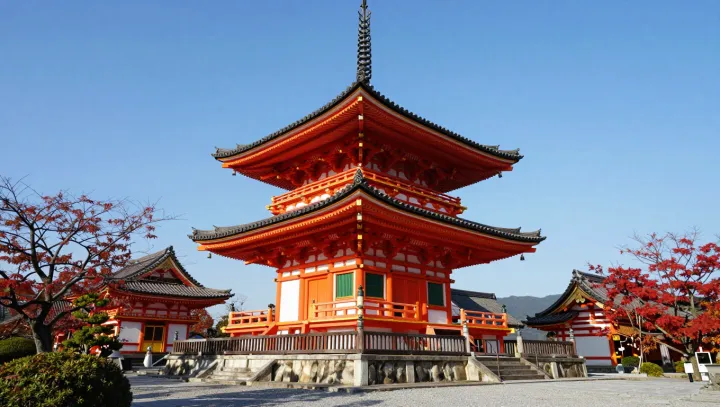
Three sweeping roofs give the pagoda its unmistakable rhythm, but the story begins with a mound. Above the vermilion woodwork rises an ornamental finial; below it, each roof marks another step in a transformation that carried a Buddhist monument from the ground toward the sky. The distance is architectural as well as geographic.
The oldest ancestor was closer to a grave than a tower. In ancient India, a stupa was a mound associated with burial and the preservation of sacred remains; Buddhist communities adopted the form to house relics and provide a focus for devotion. Its dome, often enclosed by a railing, invited worshippers to move around it in circumambulation. The shape did not travel unchanged. As Buddhism spread across Asia, its monuments absorbed local building practices, and the solid mound gradually gave way to taller structures with successive roofs.
Japan made the inherited form its own. Timber framing, broad eaves and a central pillar gave the pagoda a character suited to local temple construction, while the finial above the roof preserved a connection to the sacred monument below. Three stories do not necessarily mean three usable floors: the tower is primarily a religious structure, not an ordinary building for occupation. Some pagodas hold relics; others serve as monuments to the Buddha and his teaching. Beneath their rising roofs, the old idea of a sacred resting place still reaches upward.