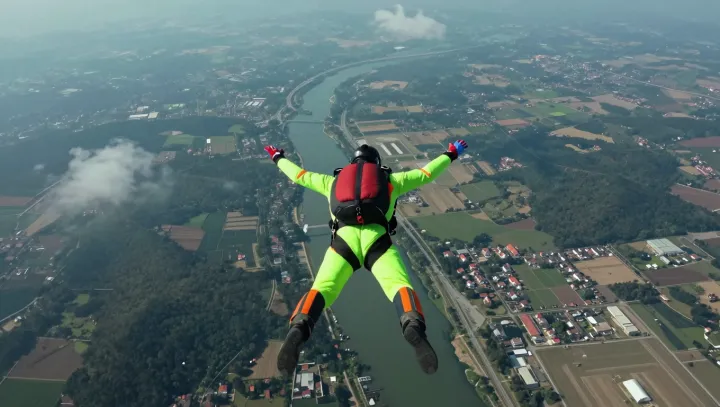
Freefall offers an illusion, not an escape from gravity. Above fields and roads, a skydiver can feel almost weightless just after leaving an aircraft because the body and its surroundings accelerate downward together. The feeling changes as speed builds and the air begins to press harder against the body.
The distinction between falling and feeling weightless matters. Gravity acts on the entire body, while apparent weight comes from forces that press or support it. Immediately after exit, air resistance, or drag, may be relatively small, so there is little of the pressure associated with standing on a floor. That sensation does not last unchanged. As speed increases, drag grows, spreading pressure across the body and producing a strong rush of air. At terminal velocity, drag balances gravity and downward acceleration stops. The skydiver is still falling, but is not physically weightless: the air is supporting the body against gravity.
The parachute makes that invisible support unmistakable. Its open canopy greatly increases drag, slowing the descent and transferring force through the harness. During that deceleration, the pull can feel much stronger than ordinary weight; once the descent settles, the harness continues to support the jumper. Body position, equipment and air density all affect the speed and sensations of a jump. What first felt like an absence of weight gives way to the pressure of air, and the earth below seems to wait.