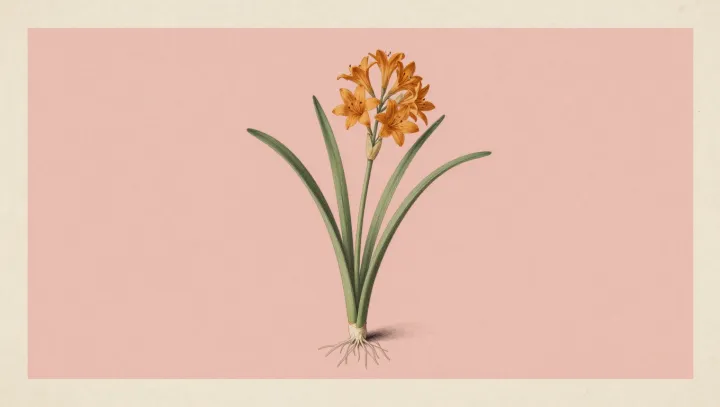
The orange flowers are only half the story. Beneath Ixia miniata lies a compact reserve that keeps growth possible when its leaves have died back. It is not a bulb. The plant, a member of the iris family, relies instead on a corm: a swollen underground stem.
The distinction is more than botanical bookkeeping. In a corm, the bulk of the stored food sits inside solid stem tissue, where carbohydrates produced through photosynthesis are converted into starch. When growth resumes, enzymes break that starch down into sugars, which supply energy and materials for emerging shoots and roots. The leaves pay the bill. As they grow, they make more carbohydrates, replenishing reserves in a new corm that forms above the old one, which is depleted as it supports growth.
A bulb follows a different design. It has a short stem at its base, but its main reserves are held in thick, fleshy leaf bases arranged in layers, as in an onion. Cut across a corm and the interior is mostly solid; its dry outer covering consists of protective leaf remnants, not the swollen storage layers of a bulb. Both structures can carry a plant through an unfavorable season, yet their anatomy tells different stories. Above ground, slender leaves and orange blossoms claim the eye; below it, a quiet stem holds the means for their return.