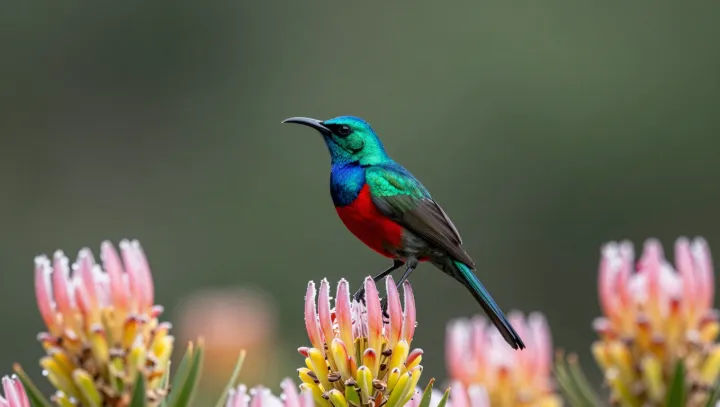
The blue tit's crown carries a message that human eyes cannot read. Its blue feathers reflect ultraviolet light as well as the wavelengths visible to us, giving other birds a view of the crown that differs from our own. The difference matters. A familiar flash of blue may be part of a richer display.
The color is more than pigment. Within the feather, microscopic structures made partly of keratin scatter light, producing structural coloration; the arrangement of those structures helps determine which wavelengths are reflected. The Eurasian blue tit also wears blue wings, white cheeks and a yellow underside, but its crown is a particular focus for researchers studying visual signals. Birds see it differently. Many birds, including blue tits, have ultraviolet-sensitive cone cells in their retinas, allowing them to distinguish aspects of plumage that escape unaided human vision.
A bright crown is not a simple certificate of quality. Studies suggest that ultraviolet reflectance can vary with sex and condition, and experiments have investigated whether it influences mate choice or interactions between rivals. Yet light, viewing angle and the bird's surroundings can alter how a display is perceived, while a preference observed in one setting need not hold everywhere. Interpretation requires care. The crown may offer clues, not a complete account of its owner's health or prospects. On a branch, the bird presents its colors to two audiences: one that sees blue, and another that sees more.