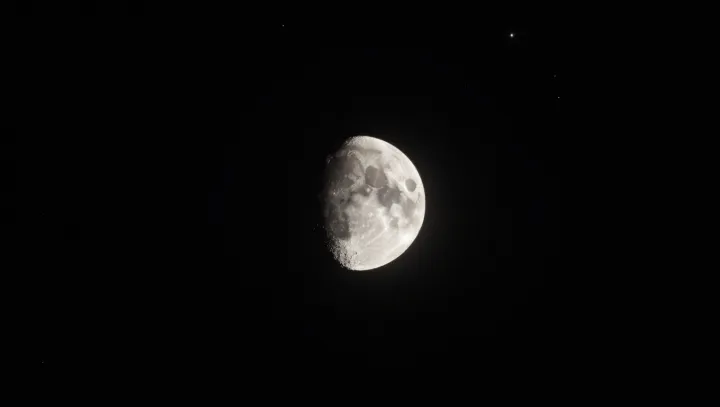
The Moon is slowly robbing Earth of rotational speed. With each passing century, the satellite drifts roughly 3.8 centimeters farther away, while the length of a day stretches by about 1.8 milliseconds. This subtle exchange is not visible to daily life, but it is firmly measurable with modern instruments that track distance and time with extreme precision.
The underlying engine is tidal friction, a process rooted in orbital mechanics and conservation of angular momentum. Gravitational pull raises tidal bulges in Earth’s oceans and crust, and because Earth spins faster than the Moon orbits, those bulges are dragged slightly ahead. Friction between water, rock and the seafloor converts rotational kinetic energy into heat, while a torque transfers angular momentum to the Moon, pushing it outward.
Laser ranging experiments, which bounce light off reflectors on the lunar surface, have confirmed the drift rate to centimeter accuracy. Geological records of ancient tidal patterns indicate that days were significantly shorter in Earth’s distant past, consistent with the same physical mechanism operating over vast timescales. The future calendar remains the same, but the planet’s rotation continues its quiet slowdown.