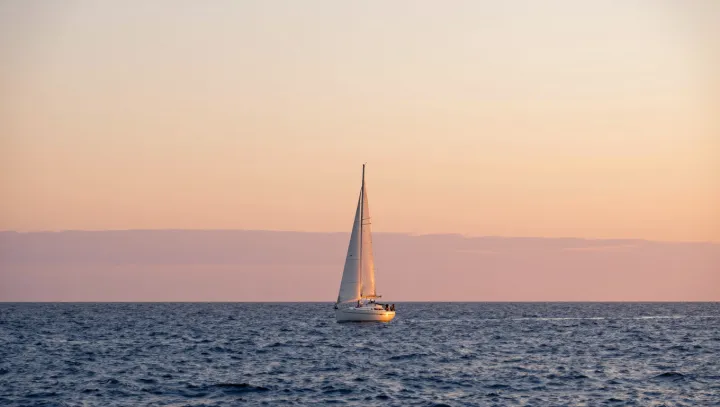
Apparent wind, not the breeze you feel on shore, governs speed in Olympic sailing. When a boat cuts across the true wind at a precise angle, hull and sails generate aerodynamic lift and reduce hydrodynamic drag enough for the vessel to move faster than the air that drives it.
The physics is closer to an aircraft wing than to a traditional downwind cruise. Sails act as asymmetrical airfoils, creating pressure differentials that translate into forward thrust, while lightweight hulls and hydrofoils minimize turbulent boundary layers in the water. By sailing on fast-reaching and upwind courses instead of pointing straight downwind, elite crews constantly reshape the vector of apparent wind over the rig, keeping a high Reynolds number flow attached to the sail surface and delaying stall.
Modern Olympic classes sharpen this effect. Skiff hulls plane over the surface, and foiling boards lift boats almost clear of the water, shrinking wetted area and cutting viscous drag. Onboard instruments track boat speed, heel angle and wind angle in real time, but winning still depends on human decisions: when to bear away to build apparent wind, when to feather the sail to prevent cavitation along the foil, and how aggressively to trade angle for velocity made good toward the mark. In this regime, the fastest crews do not overpower the wind; they reconfigure it.