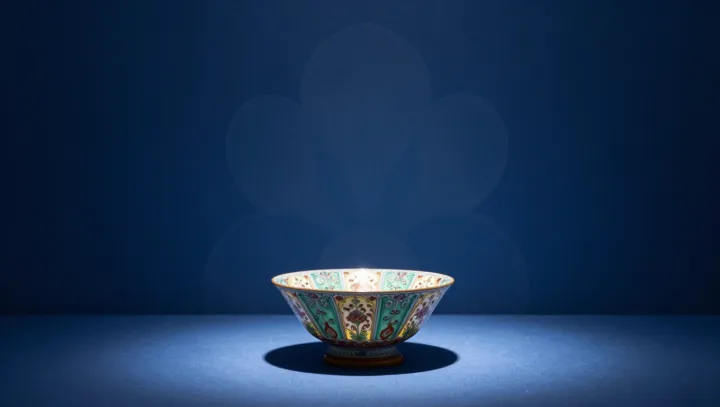
Five-color porcelain does not stop at five pigments; it works like a compact laboratory of light and chemistry on a single vessel. Each hue is built through stacked coats of glaze, where mineral compounds overlap, diffuse into one another, and react under heat. What looks like one band of green may be a thin, translucent blue over an iron-bearing yellow, fused in the kiln into a new optical state.
At the core is the physics of light scattering and refraction. Slight shifts in glaze thickness, silica content and firing temperature alter how photons travel through the glassy layer, creating gradients, halos and shadow tones that painters cannot simply mix on a palette. Color also emerges from solid-state reactions: copper oxides, iron oxides and cobalt compounds change valence and crystal structure as the kiln atmosphere moves between oxidation and reduction, generating micro-variations within each supposed primary shade.
This makes five-color ware less a counting system and more a framework for managing complexity, comparable to how marginal effects describe incremental change in economics rather than total value. The named colors are reference points; the real visual field is continuous, shaped by entropy-driven diffusion inside the glaze and by microscopic phase separation that splits a single stroke into many tones. The result is a spectrum that exceeds any literal reading of its own name, sustained by craft decisions at every layer of the ceramic surface.