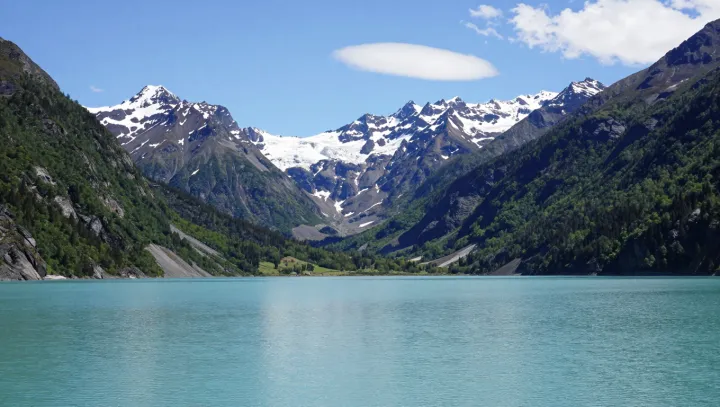
From the tourist trail, the front of Briksdalsbreen looks fixed, like architecture in ice. In reality, the glacier behaves as a slow river of solid water, creeping downslope under its own weight and continually reworking the valley that frames it.
The illusion of stillness comes from the glacier’s timescale. Ice crystals deep inside the body deform under stress, a process known as plastic deformation, allowing the mass to flow even though individual crystals remain in a solid phase. Under high pressure at the base, meltwater acts as a lubricant, enabling basal sliding over bedrock. Together, these mechanisms move ice at rates that feel static to a casual visitor but are fast enough to shift crevasses, tilt seracs, and transport debris.
As the glacier advances and retreats, it performs continuous mechanical work on the landscape. Abrasion grinds rock beneath the ice into fine glacial flour, while plucking tears larger blocks from the bed, steepening cliffs and deepening the valley floor. Stress concentrations near the surface open crevasses and trigger calving, audible as cracks and booms that betray internal strain. Briksdalsbreen therefore operates less like a frozen monument and more like a moving conveyor of ice and stone, quietly carving the Norwegian terrain.