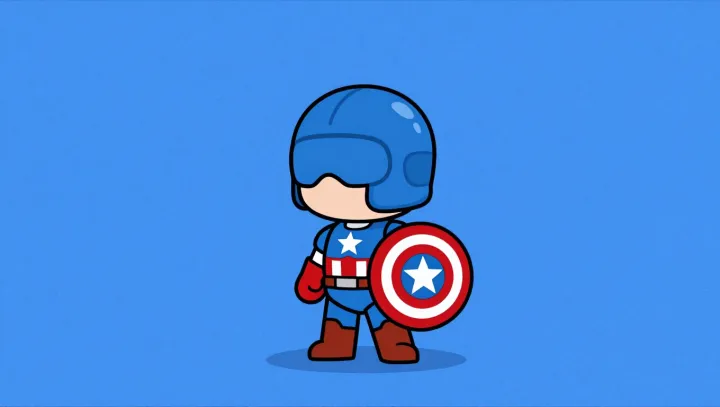
A sparse cartoon face, drawn with only lines and dots, often anchors itself in memory more firmly than a richly shaded portrait crowded with detail. Visual cognition research suggests that simple designs exploit two core features of the brain: limited working memory and a bias for clear, high-level categories.
When the visual cortex parses a face, it must compress raw input into features such as eye spacing and mouth curvature, a process linked to pattern recognition and feature extraction. Minimalist characters strip away textural noise, reducing cognitive load and entropy in the mental representation. This lets key facial cues occupy more of the limited capacity of working memory, supporting faster encoding and stronger consolidation into long-term memory traces.
Hyper-detailed, photorealistic faces compete for neural bandwidth with skin pores, lighting gradients, and background clutter, which increase informational entropy without adding much to identity. By contrast, simple cartoon faces exaggerate diagnostic signals used in face perception, such as eye size or eyebrow angle, which sharpens categorical boundaries in the brain’s face-processing network. Abstraction here functions like a compression algorithm that preserves identity-relevant information while discarding nearly everything else, leaving a lean, memorable icon that the mind can retrieve with minimal effort.