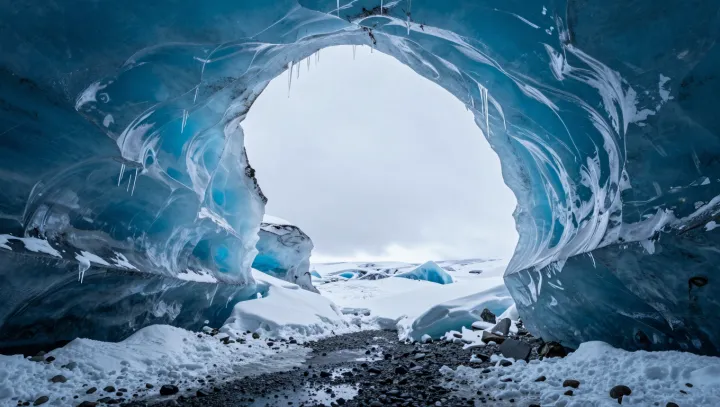
Cold air, not ice, is the real architect of a forty‑kilometer ice cave that keeps its frozen layers through warm summers. The cave’s sprawling passages shape an internal climate where moving air behaves less like a breeze and more like a deliberate routing system for heat.
At the heart of this system is density stratification, the same basic physics that drives convection in the atmosphere. Cold air is denser, so it tends to sink deeper into the cave and pool in low chambers. Those pockets become long‑term reservoirs of low temperature, while relatively warmer air is pushed toward higher entrances and slowly vented outside. The surrounding rock adds significant thermal inertia: its bulk absorbs heat only slowly, acting as a buffer that damps sudden spikes in outside temperature and stabilizes the cave’s internal energy balance.
The geometry of the tunnels then converts these principles into a kind of natural heat exchanger. Narrow shafts and vertical chimneys guide air currents so that incoming warm air has maximum contact with chilled rock and ice, losing energy before it can penetrate the deepest zones. Some passages function like return ducts, allowing slightly warmed air to rise and escape while keeping dense, cooled air trapped below. Over many cycles, this pattern lowers the effective heat flux reaching the ice, so melting stays limited and winter cold is efficiently stored.
In that way, the cave mimics an engineered refrigeration system without compressors or coolant, relying instead on gravity, fluid dynamics and the slow, steady bookkeeping of thermodynamics.