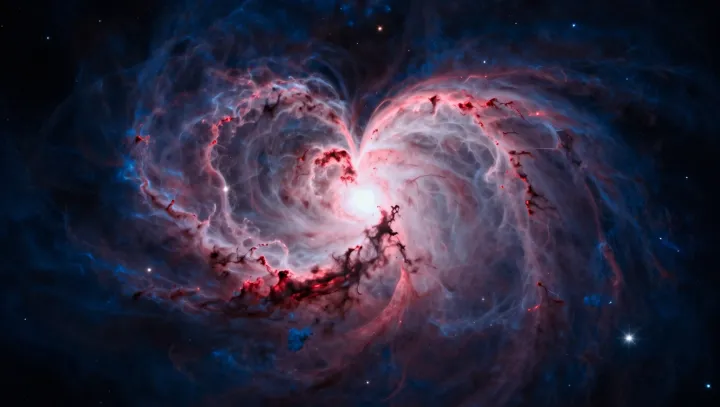
Galactic disks whirl like vast hurricanes of stars, gas and dust, yet their visible mass is nowhere near enough to keep those stars bound on such fast orbits. Measurements of orbital velocity show that stars far from a galactic center move almost as quickly as those nearer the core, defying the simple expectations of Newtonian dynamics when only luminous matter is counted.
This mismatch appears in galaxy rotation curves, where speed stays roughly flat instead of dropping with distance as Keplerian motion would predict from the inverse square law of gravity. To reconcile the observed centripetal acceleration with the gravitational pull, astrophysicists infer a massive, invisible halo that extends far beyond the bright disk. This halo, made of non‑baryonic dark matter, deepens the gravitational potential well without emitting light or absorbing it in any detectable way.
Computer simulations of structure formation show that when dark matter dominates the mass budget, it naturally forms these extended halos, providing the hidden mass needed to stabilize the spinning disks. In this picture, every luminous spiral galaxy is embedded in a much larger, unseen scaffold, and the graceful rotation of its stars simply traces the contours of that invisible architecture.