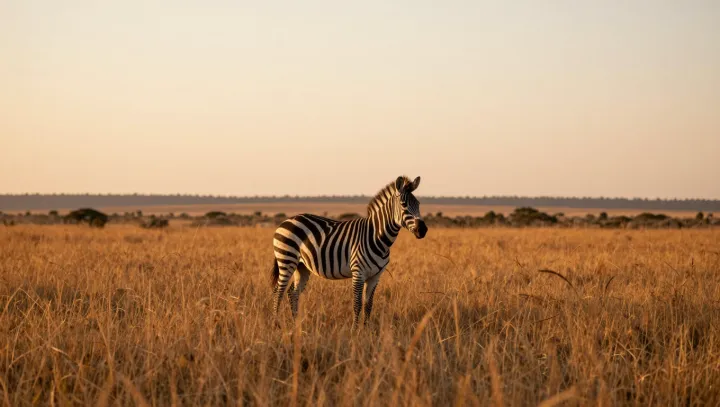
Black‑and‑white stripes do more than decorate a zebra; they reprogram the hunting problem for lions and hyenas. Each animal carries a pattern that breaks up its outline, and when many bodies move together those patterns fuse into a flickering field that confuses motion detection in the predator’s visual cortex. Evolution has tuned the contrast and spacing of stripes to work at the exact distances where an attack is launched.
That optical trick is amplified by herd behavior. Zebras align, surge and wheel as a unit, turning the savanna into a moving barcode that hides any single target. This reduces a predator’s ability to lock on, increasing the entropy of the chase and raising the marginal cost of every failed sprint. Natural selection favors individuals that keep formation and match the group’s acceleration, so the social algorithm becomes as important as muscle power.
Zebras also manage fatigue with a sleep strategy built around micro‑naps. Short, fragmented bouts of non‑rapid‑eye‑movement sleep allow the brain to restore neural circuits without fully surrendering vigilance or basic metabolic rate. Different group members doze at slightly different moments, maintaining a rotating watch that keeps sensory systems online. The result is a prey species that is not the fastest or strongest on the plain, but one whose visual design, collective choreography and sleep physiology together tilt the odds away from the hunter.