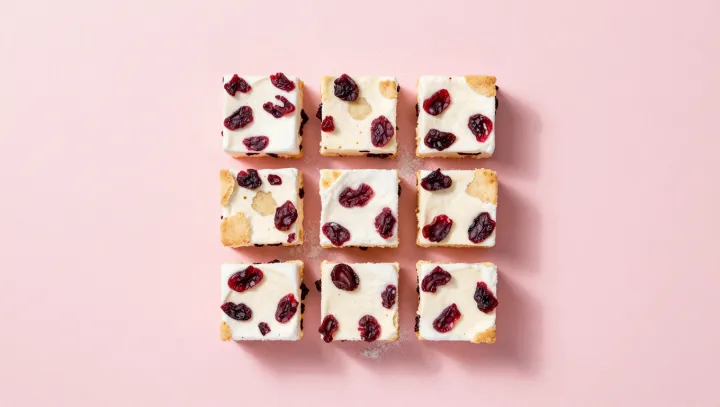
Chewy cranberry nougat holds a quiet piece of food physics: it is engineered to keep sugar disordered. Instead of forming neat crystals, the sugar phase is locked into an amorphous glassy matrix, more like frozen syrup than rock candy. That disordered state is the core reason the candy stretches rather than shatters.
Nougat recipes push the system away from equilibrium crystallization. Whipping hot sugar with egg white proteins traps air and creates a viscous foam, while added fat from butter or cream coats sucrose surfaces and disrupts crystal nucleation. Glucose syrup or invert sugar, rich in glucose and fructose, introduces molecular irregularity that raises viscosity and interferes with lattice formation, acting as a built-in anti-crystallization agent.
Water activity becomes the quiet regulator. The mixture is cooked enough to drive off free water, increasing glass transition temperature, yet not so far that the phase collapses into brittle glass. Cranberry pieces add organic acids and soluble pectin, which bind water and further slow molecular mobility. Low diffusion, high viscosity and mixed sugars keep sucrose trapped in a metastable, rubbery network, so the nougat remains soft and stretchy on the shelf rather than drifting toward the ordered hardness that sugar would prefer.