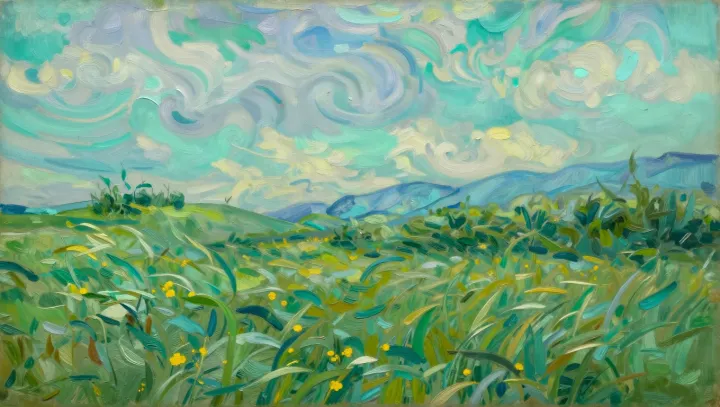
Thick strokes of yellow and blue cut across a quiet rural field, and that visual clash is now feeding brain research. Neuroscientists have turned to Van Gogh’s canvases as ready‑made experiments in extreme contrast, dense texture and directional lines, all of which place heavy load on the visual cortex and motion‑sensitive pathways.
Van Gogh’s habit of pushing complementary colors to the edge of saturation creates strong local contrast that drives lateral inhibition in retinal circuits and boosts edge detection in the primary visual cortex. His repeated, vortex‑like strokes form implicit motion vectors that activate motion perception networks typically studied with moving gratings. When viewers report a sense of swirling or pulsing, researchers can correlate that subjective motion with specific patterns of brushwork and chromatic contrast, then test these correlations with functional neuroimaging and computational models.
Emotion enters through the same circuitry. Color contrast and luminance gradients modulate arousal systems and limbic structures, while compositional tension alters predictive coding in higher‑order visual areas. Van Gogh, working without neuroscience, iterated toward an intuitive exploitation of these mechanisms, turning a rural field into a controlled stimulus set for studying how the human brain couples vision, motion and affect.