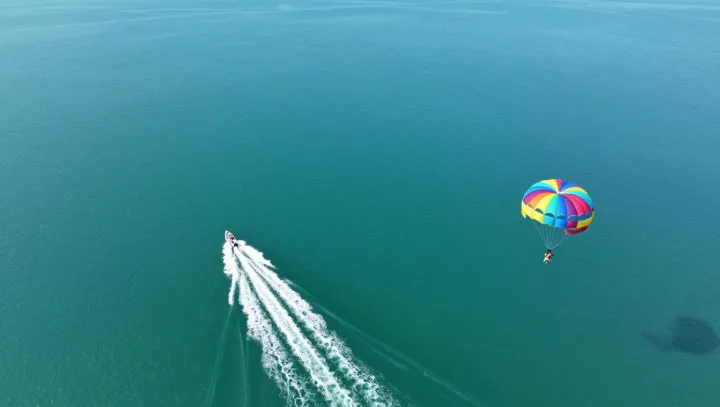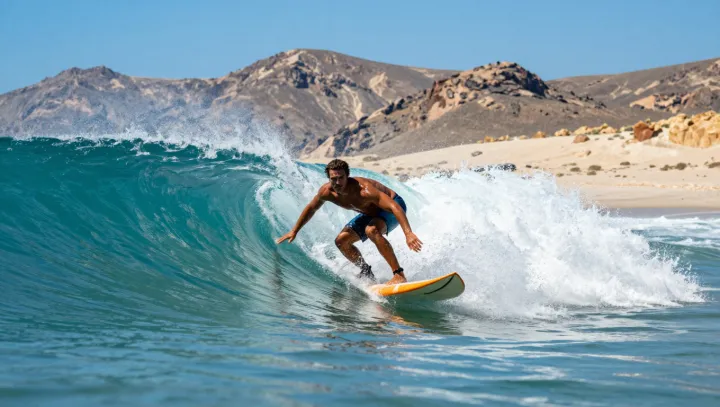
Glass‑smooth desert water suddenly throws a shoulder of surfable green. On Lake Mead, a man‑made reservoir with no lunar tides, the energy source is not distant storms but passing hulls. Powerboats inject mechanical energy into the water column, generating wakes whose amplitude and wavelength can rival small ocean swell when speed, displacement and hull shape align.
Once created, those wakes are sculpted by the reservoir’s geometry. Steep, concave shorelines and submerged ledges act as bathymetry, refracting and focusing wave fronts in ways familiar from coastal headlands. Constructive interference and resonance, classic wave superposition effects, can stack multiple boat wakes into a single, clean face that peels along rock walls like a miniature point break.
In narrow coves, reflected waves set up standing waves, a phenomenon described by basic fluid dynamics and similar to hydraulic jumps in spillways. Surfers time their paddles to a specific boat trajectory, effectively treating the vessel as a mobile storm generator. The scene looks improvised, yet it is a live demonstration that surfable waves depend less on saltwater and tides than on energy input, boundary conditions and wave mechanics.