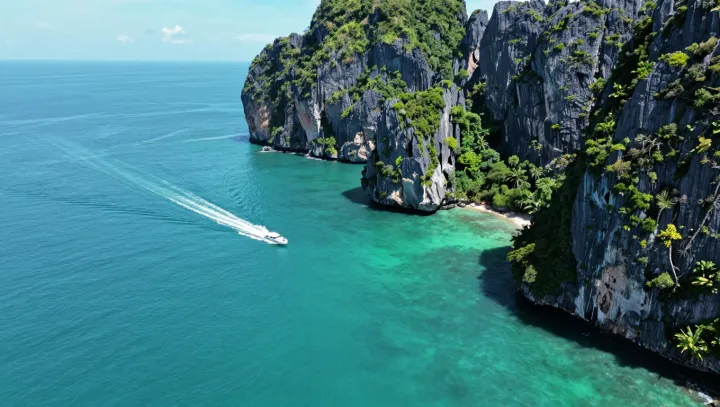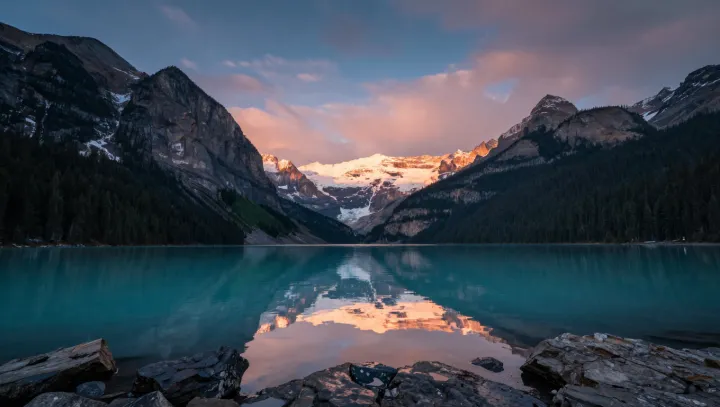
That surreal turquoise at Lake Louise is not a dye, not a chemical spill, and not a filter trick. The water is almost pigment-free. The color is engineered upstream, where moving ice grinds bedrock into ultra-fine particles known as rock flour, then flushes them into the lake with meltwater.
Rock flour behaves less like sand and more like a cloud of microscopic mirrors. Each grain is small enough to remain in suspension, turning the lake into a giant colloid rather than a clear basin. When sunlight enters, shorter wavelengths in the blue and green range are preferentially scattered back toward the surface, a process rooted in Mie scattering and familiar from atmospheric optics. Longer red wavelengths tend to pass deeper or be absorbed, stripping warm tones from the reflected spectrum.
The effect depends on concentration, particle size distribution, and the angle of incoming light, not on any intrinsic chromophore in the water. In seasons when inflow slows and sediment settles, the hue can fade toward more conventional blue. As glaciers retreat and their mechanical weathering weakens, the rock-flour supply becomes a silent variable in the future palette of Lake Louise.