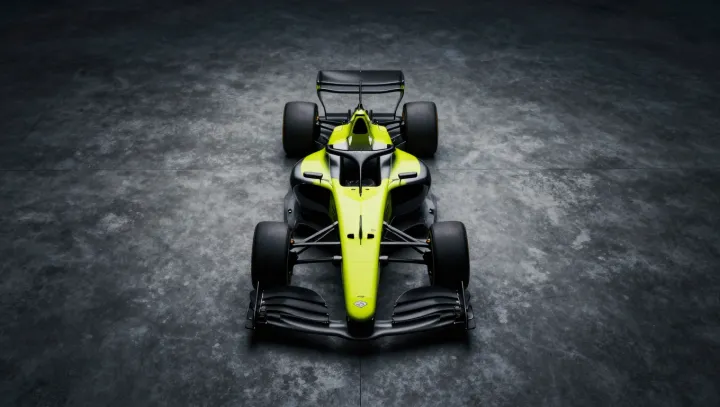
Air pressing on a race car’s body can create a load greater than the car’s own weight, strong enough that at racing speed the vehicle could, in theory, run upside down without falling. That outcome is not a party trick; it is the central design choice behind modern top tier race machines.
Engineers exploit Bernoulli principle and pressure differential to turn air into a structural force. Wings and diffusers are shaped as inverted airplane wings, generating downforce instead of lift. Through ground effect, the narrow gap between floor and track accelerates airflow, dropping static pressure and sucking the chassis downward. The result is a vertical force vector that multiplies available tire grip and raises the limit of lateral acceleration in corners far beyond what mechanical grip alone would allow.
The price is aerodynamic drag, the resistive force that tries to slow the car as velocity rises. Designers accept this penalty because lap time, not peak speed, is the metric that matters. With greater normal force on the tires, friction coefficient and contact patch utilization improve, allowing later braking and higher mid corner speed. Power units are sized and geared to push through the drag wall, converting chemical energy into the kinetic and thermal energy needed to sustain that airflow. The theoretical ability to stick to a ceiling is simply a vivid way to express how far this trade off has been pushed.