Glass cases mislead. Behind those fossil jaws and faded taxidermy, a natural history museum now functions as a single integrated research machine, where public galleries are only the visible shell of a much denser scientific core.
What looks like static display is in practice a live archive, and that judgment matters because the same bones and pinned skins that once illustrated empire now feed high‑throughput sequencing, isotope geochemistry and phylogenetic analysis, letting geneticists pull environmental DNA from century‑old tissue while geologists read stress histories from rock fractures and microfossils stacked in compactors below the floor.
The bigger claim is that no specialized institute can match this building’s breadth, since only a museum that stores entire ecosystems in drawers can let seismologists, evolutionary biologists and paleoecologists interrogate the same stratigraphic layers, so sensor arrays under the site log ground motion as curators map fossil turnover, and both datasets loop back into models of extinction cascades and biogeographic range collapse that are calibrated against real specimens rather than abstract simulations.
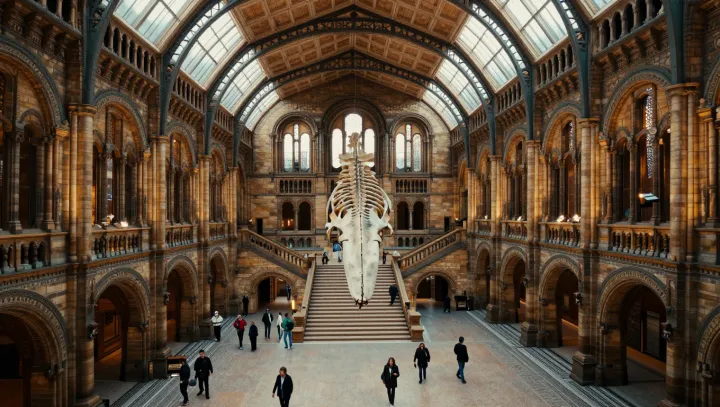
Most surprising is how short the distance is between wonder and workflow, because a visitor can walk from a reconstructed dinosaur skeleton past a cabinet of trilobites into a glass‑fronted lab where barcoded vials, reference genomes and thin sections all trace back to the very objects on display, turning an afternoon stroll into a compressed tour of Earth history, from molecular mutation to tectonic rupture to the sudden disappearance of entire faunas.