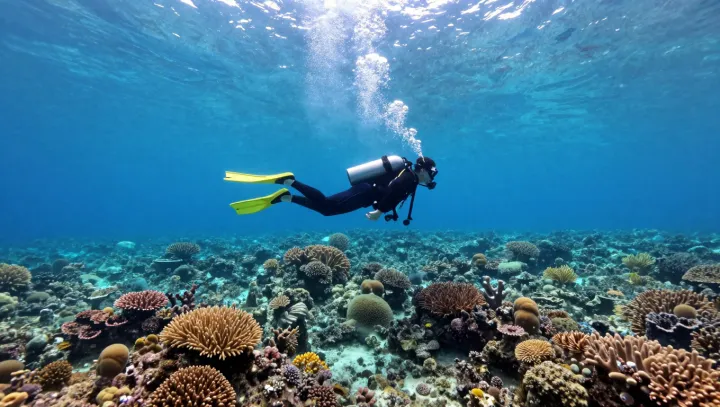
Clear water lies. Sunlit coral, fifty meters of visibility, no waves. Then a diver drops over the lip of a vertical wall and the water itself seems to move sideways, then down, while the gauge spins faster than the brain can keep up.
The harsh truth is that so-called easy tropical sites often stack hidden physiological and physical stressors in a way cold, murky quarries rarely do. Nitrogen narcosis, a narcotic effect of elevated partial pressure of nitrogen on the central nervous system, quietly erodes judgment as depth increases, so a thirty-meter plan becomes a forty-meter mistake and a fifty-meter spiral. That loss of executive function hits precisely where many famous walls and blue holes drop into open ocean, far beyond recreational limits, with no visual floor to trigger caution.
More deceptive still is the water column itself, which is anything but uniform in these postcard locations. Sharp thermoclines, created by stratification of warm surface layers over colder deep water, can deliver an abrupt temperature drop that spikes respiratory rate and gas consumption just as narcosis thickens thought. At the same ledges, powerful downcurrents form when horizontal currents strike a wall and are deflected downward, creating vertical jets that may exceed a diver’s finning capacity. Those flows can pin a body to the wall, inflate a buoyancy compensator uselessly, and drag a diver so deep that decompression obligation and oxygen toxicity risk compound the original problem. Paradise, in these places, is not gentle; it is finely tuned to punish even small errors in depth control and gas planning.
What looks like calm blue water above, and a simple drop over a coral lip, can in reality be a layered machine of gases, pressure and moving density, waiting for one more diver to trust the view instead of the physics.