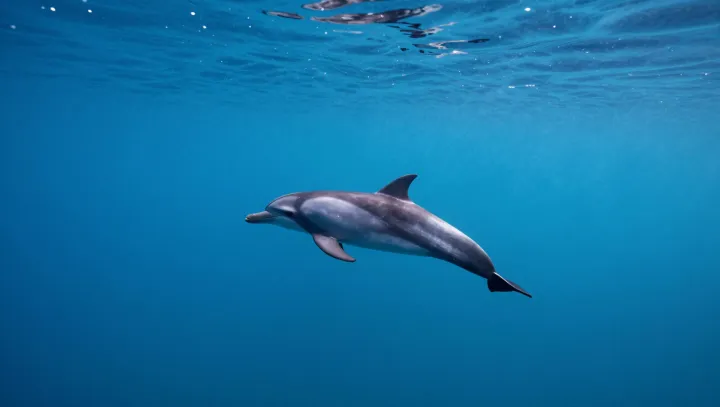
Self-awareness, not tool use, may be the sharper line between human minds and other animals. Bottlenose dolphins keep stepping across that line, as research on mirrors and sound tags known as signature whistles keeps stacking up in controlled tanks and open-water enclosures.
The mirror test looks simple. A mark is placed on the body where only a reflection can reveal it, and behavior around a mirror is recorded under standardized ethological protocols. Chimpanzees pass. So do some corvids. Dolphins join this narrow club, twisting, rolling and positioning the marked area in front of the mirror in patterns that match self-directed inspection, not social display or random motion.
Yet social memory may be the more unsettling finding. Each dolphin develops an individually distinctive whistle contour, a kind of acoustic identifier produced through vocal learning and governed by fine control of the laryngeal sac and associated respiratory musculature. Playback experiments show that a dolphin will respond selectively to the whistle pattern of a long-absent associate, even when no other cues are present and no reinforcement follows.
What emerges is not a simple call-and-response routine but a network of stable identifiers, stored with high fidelity in long-term memory structures that neuroanatomists link to the hippocampus and prefrontal cortex analogues. A dolphin can recognize its own reflection, remember another’s “name” after prolonged separation, and link that acoustic trace to a specific social partner. The gap between human and nonhuman minds narrows by one more, very audible, step.