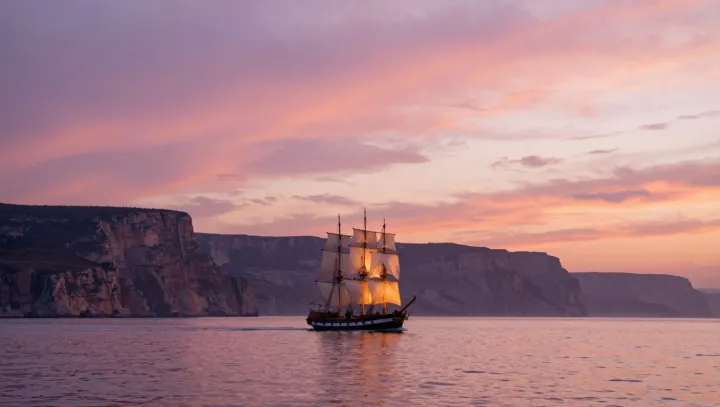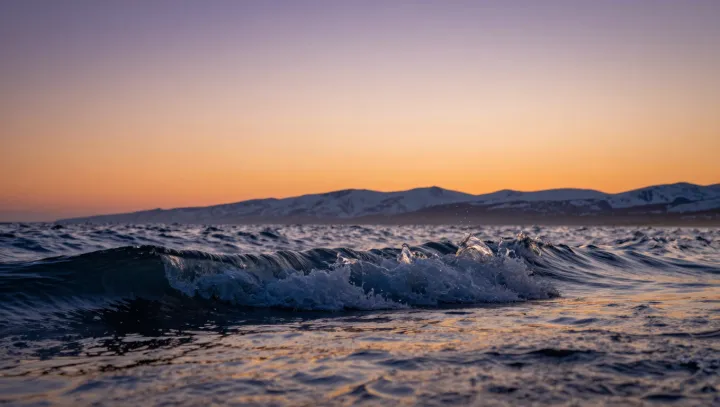
That quiet sunset sea is a bully in disguise. Glassy on the surface, its long, rounded swells carry a form of power that makes a single highway car look modest. Kinetic energy scales with both mass and the square of speed, and while the water moves slowly, the sheer quantity of it changes the math.
The basic claim is blunt. Mass wins. A car may rush along at high speed, but its mass is limited and fixed. A wave train, driven by distant winds and pressure gradients, sets in motion layers of water that extend far below the surface. Even at one or two meters per second, that moving column of dense fluid adds up to an enormous term in the kinetic energy equation, one half m v squared.
Hidden too is structure. What looks like a lazy roll is a coherent packet of energy described by wave dispersion and group velocity, not just by the height of the crest you see. Each swell gathers motion from a wide patch of sea, so the effective mass tied into that slow rise and fall is far larger than the thin shell of metal and plastic surrounding a car. Low velocity, multiplied by ocean-scale mass, beats high velocity attached to a single machine.
The counterintuitive part is psychological. Eyes track speed, not inertia. People notice spray, noise, and sharp acceleration, so the car reads as powerful while the sea reads as calm. Physics is indifferent. That almost frozen horizon, barely breathing under the fading light, is quietly carrying enough kinetic energy to swallow fleets, not just sedans.