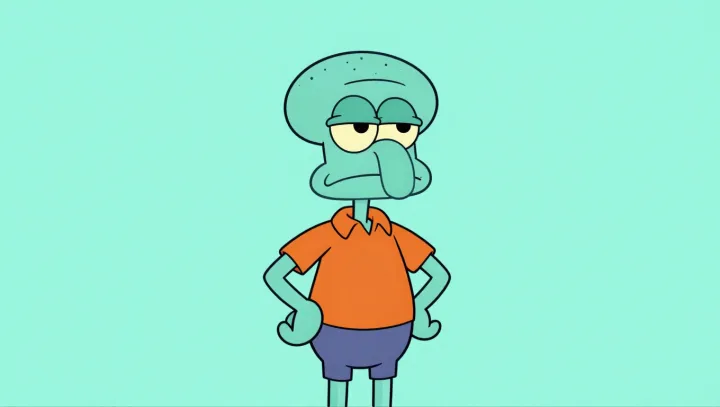
The odd thing is that Squidward would not stay Squidward for long. A real octopus nervous system, with most neurons in the arms rather than the head, does not support a rigid, sitcom-style identity; it supports a shifting coalition of semi-independent control centers.
His sarcasm would lose its monopoly. Local ganglia in each limb, wired for autonomous motor control and rich sensory input, would start making low-level decisions that never reach a central narrator. One arm might explore a clarinet on its own feedback loop of proprioception and tactile processing, while another probes the seabed, each running its own quasi-habits. What viewers read as a single grump would fracture into parallel micro-intentions distributed across his body.
The bigger shock is that his grudges would be unstable. Octopus neural tissue shows extreme neuroplasticity and can regenerate after injury; any “memory trace” encoded in synaptic weights is less like a carved bust and more like wet sand. Chronic resentment of SpongeBob would have to compete with constant rewiring driven by new stimuli, altered chemotaxis, and shifting sensory maps. The classic, static character arc would be replaced by something closer to a dynamic control system whose personality drifts as easily as its arms reconfigure around a rock.