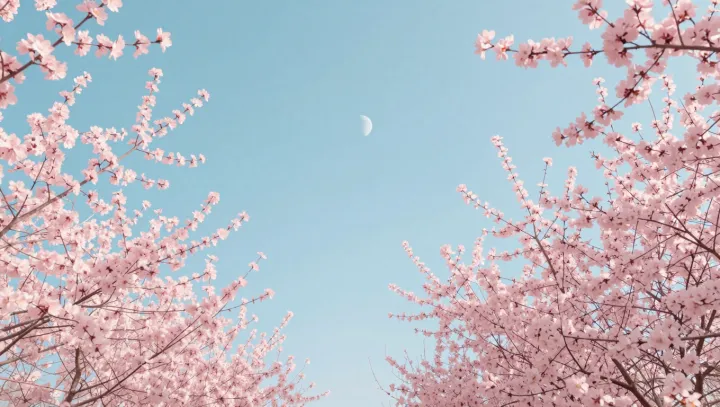
Daylight makes the Moon look like it is breaking a rule. The rule is not brightness, but geometry and contrast between two light sources in one sky. The lunar surface reflects sunlight with high albedo, and Rayleigh scattering in the atmosphere paints the background blue, so a half‑lit Moon can still stand out as a pale disk against that diffuse glow.
More surprising is how strict the geometry really is. For your naked eyes to hold Sun and Moon in the same field, the Moon must sit in a specific phase band: neither near new, when its sunlit hemisphere faces away, nor near full, when it rises close to sunset and hides from the daytime gaze, but in the broad waxing or waning quarter range where the phase angle leaves a bright limb visible while the Moon is above the horizon under daylight.
Even tighter is the second condition. The angular separation between Sun and Moon must fall below your useful viewing span, while both objects clear the local horizon at your latitude. That three‑body line among Sun, Earth, and Moon sets their apparent altitudes and azimuths, and only when those coordinates overlap your slice of sky does the quiet daytime Moon appear beside the star that lights it.