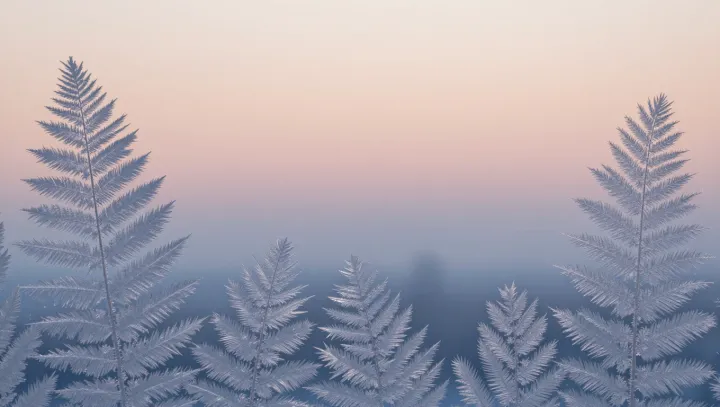
Ice on glass is not decorating. It is solving an optimization problem in thin air, using the same branching logic that shapes river networks and lightning paths through clouds, according to physicists studying pattern formation in phase transitions.
The key claim is blunt. Frost feathers grow because water molecules in supersaturated air follow diffusion gradients toward the cold glass, and that transport process, described by Laplace’s equation and captured in diffusion-limited aggregation, naturally amplifies any tiny bump on the freezing front into a growing tip that steals vapor from its neighbors and forces the pattern to branch again and again.
This is not a decorative quirk. The same Laplacian growth rules govern how stream channels drain a landscape under groundwater flow, and how an electric discharge in dielectric breakdown pushes forward where the electric field is strongest, so each advancing finger, whether of ice, water, or plasma, competes for a shared field and produces self-similar, scale-free structures with fractal dimension that falls in a narrow numerical band.
What looks like a fragile feather is therefore a frozen record of a nonlinear field, a thin archive of gradients and instabilities that, if replayed in soil or in air, would carve rivers or stitch a lightning path instead.