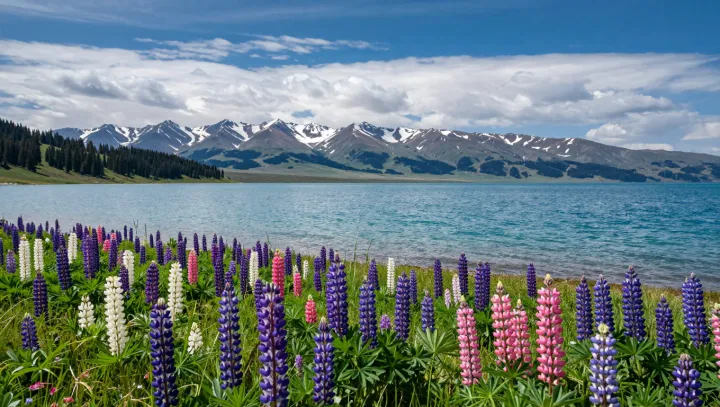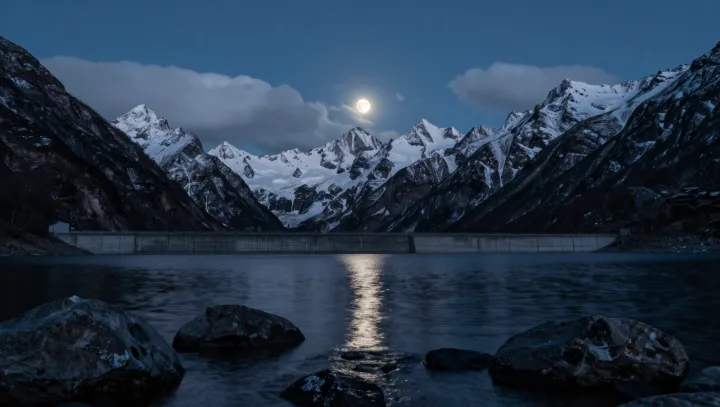
Bright mountain ridges over dark Alaskan valleys are not a poetic trick; they are geometry made visible. At high latitude, the Sun’s apparent path skims just above the horizon for many consecutive days, forming a shallow circle rather than a steep daily arc. That grazing angle turns every ridge into a light trap and every valley into a shadow well.
The key is blunt. Peaks simply see more sky. Because Earth’s axial tilt points the polar region toward the Sun, the solar declination lines up so that the star never drops fully below the horizon. Yet its solar elevation angle stays low, only a few degrees, so even modest relief creates a long umbra. Steep valley walls act like a local horizon, raising the effective cutoff angle far above the true astronomical horizon.
This means the same Sun that pours onto a summit for continuous hours never clears the rock rim that surrounds the valley floor. Radiative transfer does not care about human clocks; it follows straight lines from the solar disk. Where that line intersects a ridge, you get glowing snow and rock. Where it intersects stone before reaching the ground, you get a prolonged, almost nocturnal dimness.
Some call this contrast uncanny, but the physics is plain. Combine axial tilt, high-latitude solar geometry, and rugged orographic relief, and you obtain a split world: alpine noon overhead, twilight just a short hike below.