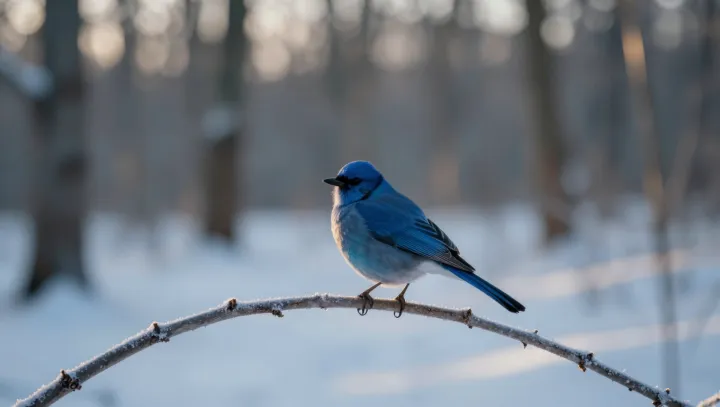
Feather blur, not freezing clarity, often carries the more honest report. In a so‑called static winter bird, a slightly slow shutter lets tiny tremors register as streaks and halos around the plumage, sketching how air, muscle tone and balance keep that body upright against the cold.
High‑speed exposures promise control, yet they censor evidence. By collapsing time to a razor slice, they erase the way contour feathers lift and settle, how down compresses with each isometric muscle adjustment, how the nictitating membrane flicks across the eye. A marginally long exposure behaves less like a stamp and more like a seismograph, translating micro‑movements into visible vectors. Those arcs of blur reveal joint articulation patterns and wing‑loading distribution that field guides never show, turning a single frame into a crude record of biomechanics.
The real gain is analytical, not aesthetic. When motion blur is intentional and repeatable, it becomes data: direction, amplitude, frequency. Compare several frames and you start to infer resting heart rate from rhythmic head ticks, or thermoregulation strategies from the periodic shiver of flank feathers. Where the fast shot insists the bird was still, the slow shutter quietly proves it was working to stay that way.