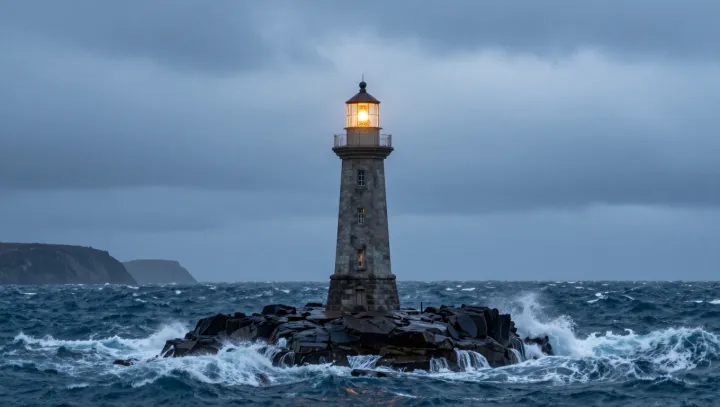
A lone stone tower often outperforms an entire coast. Thick mist erases the low, scattered glow of towns and ports, yet the lighthouse lamp still drills a narrow corridor through airborne droplets, exploiting optical physics that favor a single focused source over many weak ones.
The key is not romance but geometry. Coastal lights sit low, spread horizontally, and lose power through atmospheric attenuation long before they reach distant ships, while the tower’s height extends its geometric horizon and reduces the path length through the densest boundary layer near the sea surface. Its lamp concentrates luminous intensity into a tight beam, and the classic Fresnel lens system shapes that beam so that refraction and internal reflection squeeze more usable photons into a defined sector than a whole shoreline can scatter in every direction.
That stability is engineered, not mystical. The stone mass damps structural resonance, so in violent storms the tower sways less than flexible masts or buildings, keeping the beam alignment within narrow tolerances that mariners rely on for bearing. Redundant power supplies and simple thermal management prevent the light source from failing when surrounding grids trip. So the coast disappears first, washed out by mist and distance, while the tower, built to concentrate, elevate, and endure, remains the last fixed point on the horizon.