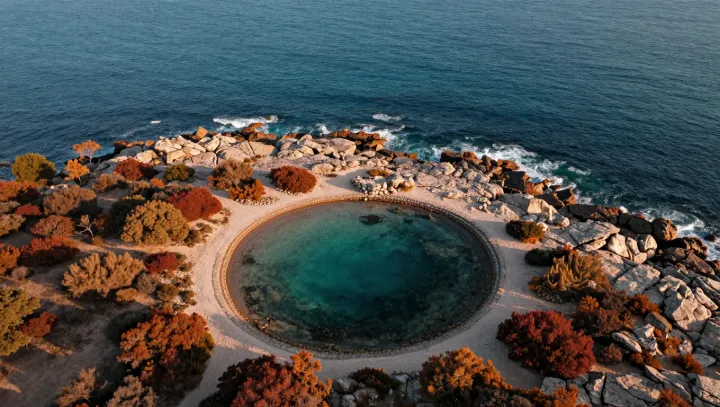
Color, not waves, is the ocean’s most misleading promise. From a distance the water looks reliably blue, yet close to shore it flickers to green or even a flat, murky brown. That shift is not mood; it is physics and biology fighting for control over each photon that enters the surface.
The blunt fact is this: pure water wants to look blue. Its molecules absorb red wavelengths slightly more than blue, a bias measured in absorption spectra that optical oceanographers treat as baseline. Strip away particles and pigments and the sea would resemble a vast, thinly tinted filter. But coasts refuse to stay pure, because rocks grind into silt, waves rip sand into suspension, and rivers inject plumes of fine mineral dust that scatter light in every direction.
Green water is not a stain, it is a takeover by biology. Microscopic phytoplankton pack chlorophyll-a, a pigment that eats blue and red bands while letting green bounce back to your eyes, a spectral trick confirmed in remote-sensing reflectance data that satellites read from orbit. Add fragments of decaying plant matter, so-called colored dissolved organic matter, and the water darkens again, shifting from jade to tea as organic molecules soak up shorter wavelengths and leave only muddied leftovers to escape.
Brown surf, too, has a blunt explanation. When storms or strong tides churn the seabed, sand grains and clay stay suspended long enough to dominate scattering, swamping the faint blue of water and the green glow of plankton alike. A narrow cove lined with pale limestone will bounce more light back through the shallows than a bay floored with dark basalt, so two neighboring beaches can present entirely different palettes even under identical sky and sun. Color, assumed fixed on postcards, is in practice a live reading of coastal geology and microscopic life, updated with every passing wave.