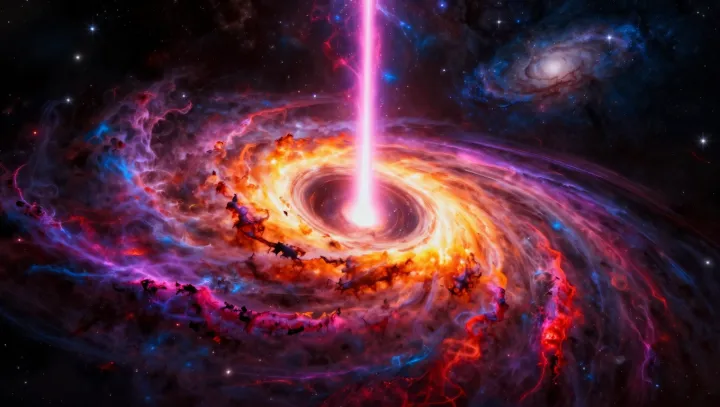
A black hole is not a packed cannonball of matter; it is a scar in geometry. Around it, general relativity says mass does not just sit in space, it reshapes spacetime itself into a steep gravitational potential well that objects cannot ignore, no matter how much empty volume surrounds them.
The unsettling part is simple. Space yields. Matter does not. When a star collapses beyond the Schwarzschild radius, no known force, not electron degeneracy pressure, not neutron pressure, can counter the inward pull encoded in the Einstein field equations, so the star’s material is driven inward while the external region remains largely vacuum.
The popular image of a point is misleading. What drives orbits is not a tiny pellet of stuff but the curvature outside the event horizon, where geodesics, the natural paths in spacetime, bend so sharply that nearby stars, gas and even dark matter settle into long-lived orbits, turning the central hole into the dynamical anchor of a galaxy.
Calling the interior empty misses the point again. What matters to the galaxy is the total mass and the resulting gravitational field, not whether the core is a true singularity or a yet-unknown quantum gravity state, so Sun-sized bodies fall, the horizon swells, and the surrounding stellar city continues to circle an absence that behaves like a mass.