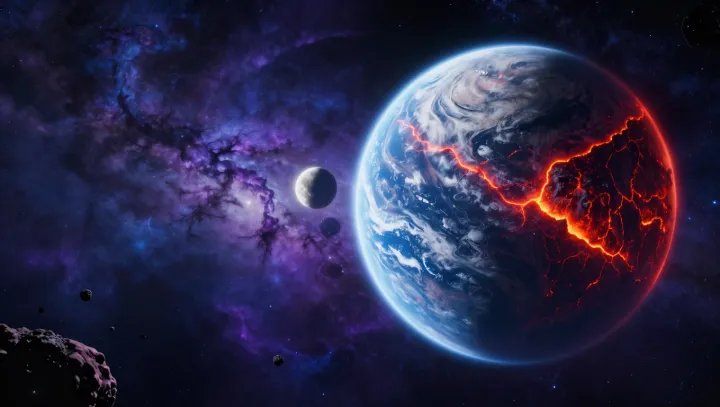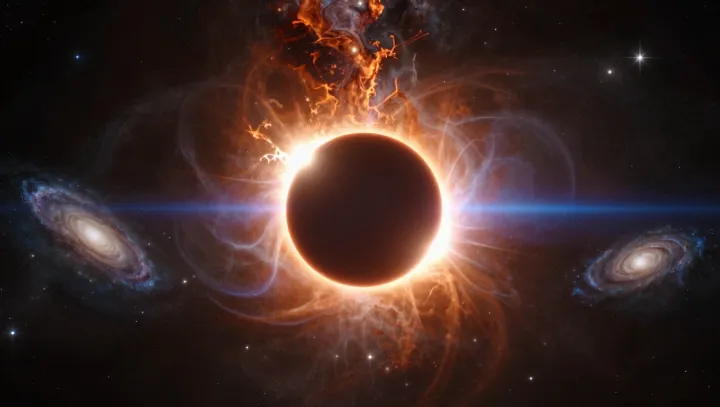
A blank sphere, not a telescope, becomes the boldest cartographer of deep space. Its surface carries no marks, yet every photon that glances off it is forced to obey Maxwell’s equations and the radiative transfer equation, quietly imprinting information about where it came from in angle, color, and intensity.
The striking claim is that this is enough. Because a perfectly smooth, isotropic scatterer has a simple bidirectional reflectance distribution function, the halo of light around it is a coded projection of the surrounding galaxies. Measure that halo in fine detail, and you sample a huge set of incoming directions and wavelengths, like a compressed archive of the sky written onto one glowing shell.
What matters is not optics hardware but mathematics. Physicists pose an inverse problem: given the observed brightness pattern on the sphere, recover the three dimensional distribution of sources that would generate it under known scattering physics. Techniques from tomographic reconstruction and inverse rendering, long used in medical imaging and computer graphics, are repurposed to solve for the galaxy layout that best explains the halo.
This approach sounds like cheating, yet it is brutally constrained. Any proposed cosmic map must, when run forward through the same radiative transfer model, reproduce the exact speckled glow on the sphere. In that tight feedback loop, a featureless object stops being empty; it becomes a dense boundary condition for the universe beyond.