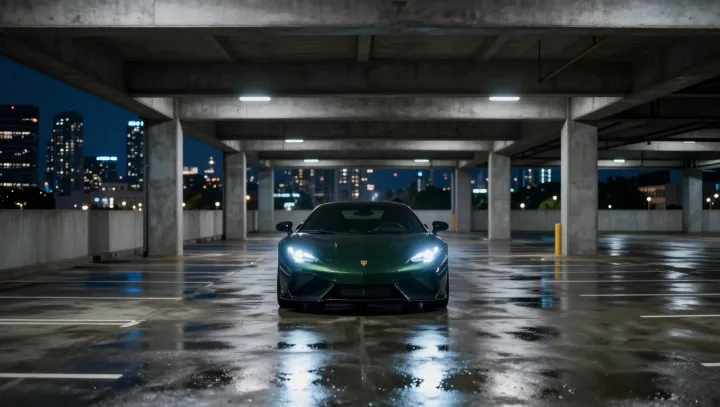
Wet asphalt is a harsher critic than most studio walls. Once water floods its jagged surface, it fills pores and stones, flattening the micro‑terrain into a continuous film that sharply boosts specular reflection and suppresses diffuse scatter, so the ground stops acting like matte rock and starts acting like a crude optical flat.
The single overhead lamp is the accomplice. One small, intense source throws a tight highlight that obeys geometric optics with embarrassing honesty, so every panel curve on a supercar either bends that reflection smoothly or kinks it into visible ripples, turning tiny deviations in panel gap, orange peel, or clear‑coat thickness into dramatic distortions you can see from meters away. Multiple soft boxes would smear that information into a flattering blur; this brutal point light preserves phase‑like directionality in the reflected rays, so the eye can track discontinuities the way an interferometer tracks fringe shifts.
The parking spot itself finishes the trick. You stand low, the car sits above the mirror, and the lamp hovers in a simple triangle that maximizes grazing angles, so the Fresnel effect drives reflectance sky‑high and pushes contrast between flawless and flawed zones until even a casual glance becomes an inspection protocol worthy of a metrology lab.