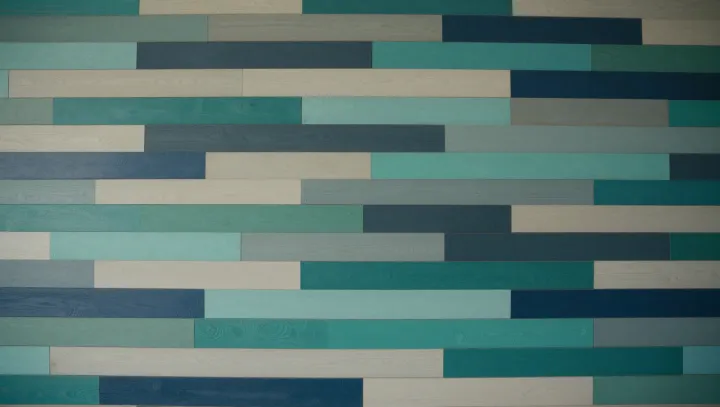
A modest plank wall makes a bolder claim than most glass towers. Its repeated boards, identical in width and spacing, quietly assert that structure begins with modules, not with mass, just as tall buildings rely on regular bays and digital images on pixel grids. Each plank is a discrete unit, a physical analogue of a pixel, and the painted surface is nothing more than a continuous illusion stitched across them.
The deeper surprise is that such a wall rehearses core structural logic. In a framed high‑rise, loads travel through a defined load path, from slab to beam to column to foundation; in the wall, gravity and lateral forces move from plank to fastener to stud to floor. Change one dimension, repeat it at a fixed pitch, and you control stiffness, deflection and failure modes with the same parametric discipline used in curtain‑wall modules or braced frames, only here expressed in softwood and primer instead of steel and glass.
Most people read only color and texture on that painted surface. Engineers see discretization and quantization at work, the same abstraction that lets an image sensor cut a scene into addressable pixels and then recombine them as a seamless picture. Where one viewer sees rustic décor, another sees a quiet diagram of how modern systems stay upright and stay sharp, by trusting small, repeatable parts to carry big, continuous effects.