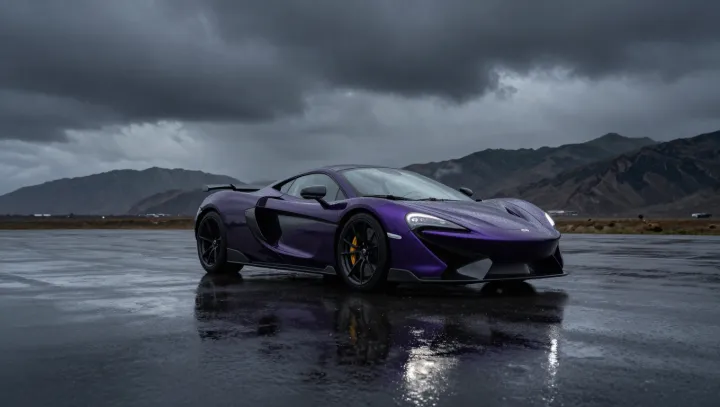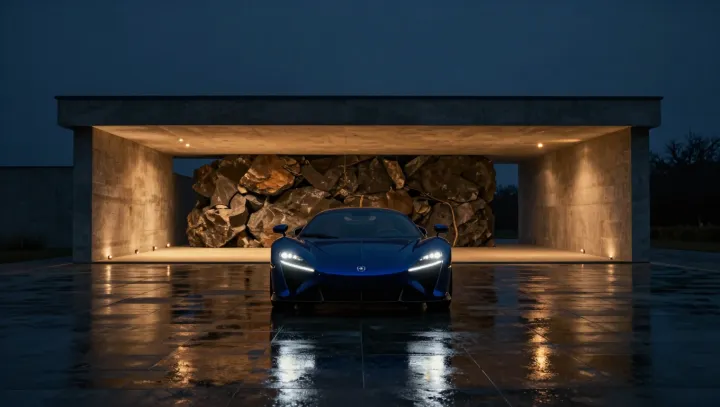
Speed sits still on the curb, yet your brain refuses to believe it. A low nose, a high tail, rain streaking along the bodywork: together they fake motion in a system that evolved to spot predators, not parking-lot sculpture.
Designers know the trick is almost rude in its simplicity. Rake angle tilts the entire body like a sprinter leaving the blocks, biasing your internal estimate of vector and acceleration long before any wheel rotates. In the visual cortex, motion-sensitive neurons in areas V1 and MT fire more eagerly when lines lean forward, so a static roofline slant becomes a directional cue your brain treats as kinematics, not ornament. Short cue. Strong push.
Even sharper is the way light is weaponized. Hard, light-catching edges create high-contrast highlights that slide along the panel as you shift your gaze, a tiny parallax show that mimics optic flow, the same phenomenon pilots rely on during low-level flight. Between those edges, compound surface curvature bends reflections into arcs, so a passing cloud appears to streak along the flank, driving motion detectors without a single meter per second of actual velocity. Park the car in the rain and every droplet becomes a tracer round, crawling along channels that were sculpted as if the designer had a direct feed into your dorsal stream.