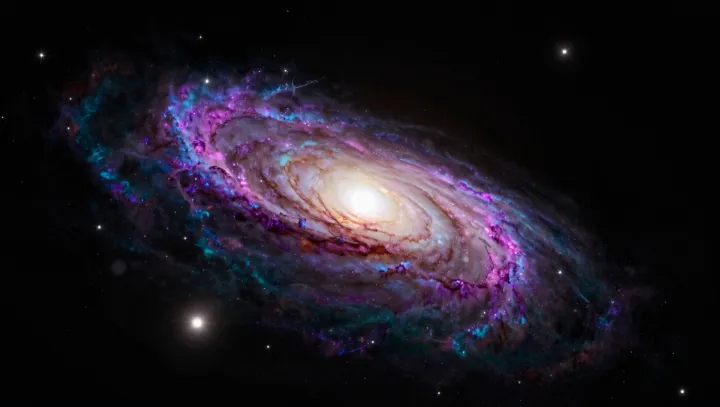
That graceful spiral is not peaceful at all. Its disk is caught in a drawn‑out gravitational contest with a neighboring system, and the still image hides the slow violence. Astronomers see asymmetries in the rotation curve, faint tidal streams of stars, and a lopsided ring of neutral hydrogen mapping the disturbance.
The unsettling truth is that beauty here is just a snapshot of imbalance. As the two galaxies orbit their shared center of mass, tidal forces stretch the stellar disk, amplifying one spiral arm, shredding another, and driving density waves that trigger bursts of star formation. N‑body simulations, which track millions of test particles under Newtonian gravity, reproduce these warped arms and off‑kilter bars when a companion passes at just the right distance and inclination.
What looks composed is really a frozen frame in a very slow fall. The galaxy’s dark matter halo and stellar disk absorb angular momentum from the encounter, twisting orbits and thickening the plane. Gas clouds are torqued into new paths, some funneled inward toward the central bulge, some flung outward into faint tidal tails. Given enough orbits, the current neat pattern will fade, replaced by a more chaotic structure that will, for a while, look stable too.