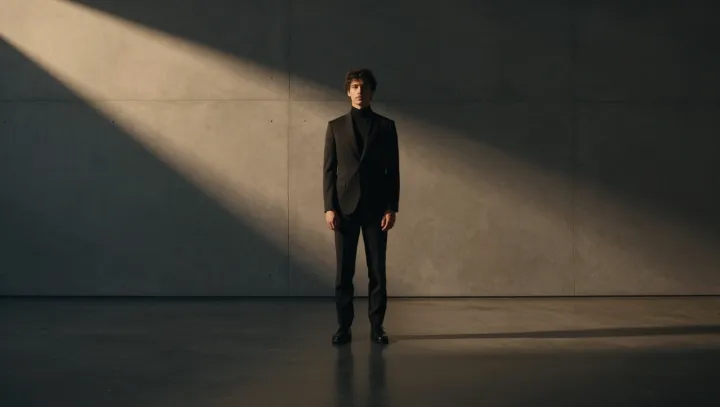
A long, heavy coat sounds like the enemy of a lean silhouette. Yet the right one can act like visual shapewear for the whole body. When fabric weight, hem length and seam placement work together, the coat stops being bulk and starts becoming a tall, narrow frame around you.
The key move is the belt. By cinching at the anatomical waist, the coat imposes a clear waist-to-hip ratio and resets your vertical proportions, so the eye reads a higher waist and longer legs. This is basic perceptual psychology: the brain prioritizes strong contour cues over fabric thickness, so the defined midline dominates while the padding recedes.
Even more powerful are uninterrupted verticals. Think of a continuous placket, a straight front opening, long lapels or a column of buttons running in one line from neck to hem. These elements create a stable vertical axis, a kind of optical vector, that pulls the gaze up and down instead of sideways. When the coat falls in a clean column over the hips, it masks lateral curves and noise from pockets or layers, compressing your visual width into that single line.
Color and styling then tighten the effect. A dark, low-contrast coat worn over a similar-value base removes horizontal breaks, so no hem, cuff or waistband interrupts the column. Heavy wool or cashmere drapes straight, reinforcing that axis instead of ballooning out. Add the belt, keep the front lines clean, and the garment that should add volume ends up editing it away.