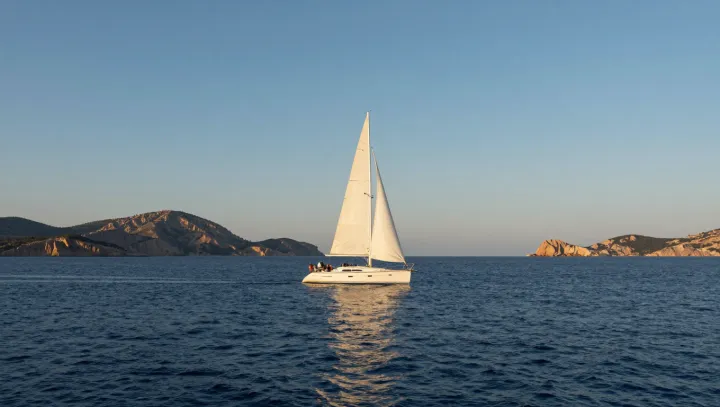
Still water can be lying. Above that motionless hull, the sail is quietly running jet physics at low speed. Air hits the curved fabric, speeds up along one face, slows on the other, and sets up a pressure gradient that looks suspiciously like the wing of an airliner.
The counterintuitive part is simple. A sail is not a cloth shovel; it is an airfoil generating lift. Bernoulli principle and Newtonian momentum both apply, so the flow bends and the resulting lift force points roughly at right angles to the sail surface, just as on a cambered wing slicing through thin air at cruise altitude.
Here is the trick. That lift is useless until geometry edits it. Resolve the lift vector into components: one sideways into the keel, one forward along the boat’s course. The keel and hull supply hydrodynamic resistance, canceling most of the sideways push through lateral resistance while allowing the forward component to drive the boat, exactly as a jet’s wing lift is redirected by engine thrust and fuselage orientation into efficient forward travel.
The boat feels slow only because human senses fixate on ground speed. In aerodynamic terms, what matters is apparent wind, the relative airflow created by true wind combined with the boat’s own motion. Change that vector and you rewrite the pressure field on the sail, the same way a slight change in angle of attack on a wing reshapes lift and drag and lets a jet cover a vast distance in a single flight.