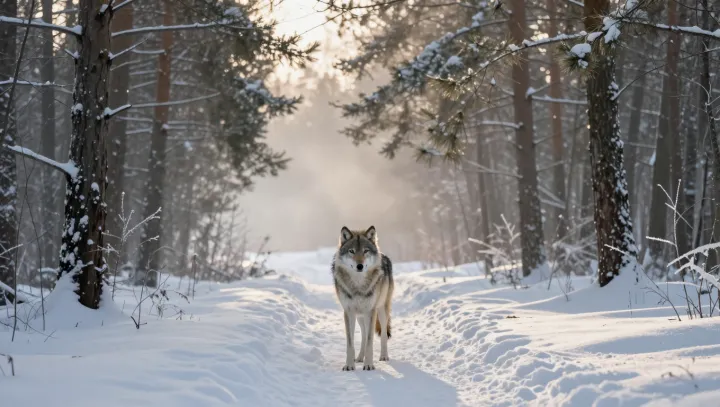
Cold does not simply threaten the wolf; it sharpens the design of its body. A lone animal can stand almost rigid in sub‑zero forests because its outer layer behaves like thermal armor, turning a lethal environment into something closer to background noise for its core organs.
That armor begins with fur density, not size. Guard hairs trap unmoving air, while the underfur forms a compact insulating matrix that cuts conductive and convective heat loss far more efficiently than any fabric. The wolf’s compact torso and relatively short extremities reduce surface‑area‑to‑volume ratio, a textbook principle of thermoregulation, so less internal heat reaches the frozen air in the first place.
The more surprising advantage lies under the skin. In the limbs, arteries and veins run in tight proximity, creating a countercurrent heat exchange system that cools blood on the way out and reheats it on the way back, limiting wasteful thermal bleed at the paws. This allows muscle activity and neural signaling to continue with minimal extra glucose demand, keeping the wolf alert without a spike in whole‑body metabolic rate.
Stillness, for the wolf, is not passivity but an energy strategy. By letting insulation, geometry, and vascular engineering carry most of the thermal load, the animal can watch, listen, and wait while burning only a fraction of the energy a moving body would spend in the same killing cold.