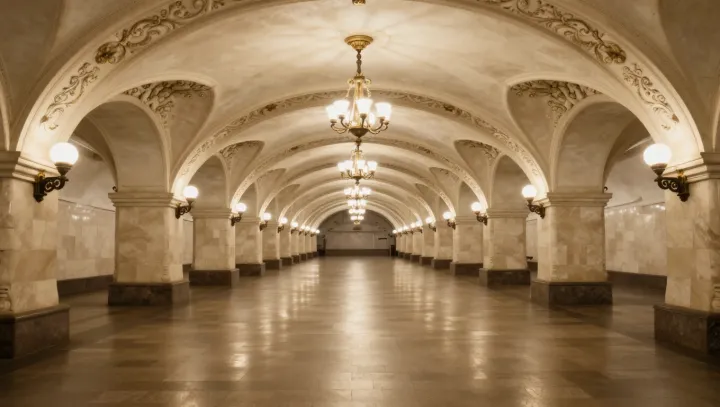
An underground corridor can feel more composed than the city above. No traffic noise. No visual clutter. Instead, a sequence of arches sets a clear spatial rhythm, an architectural version of meter in poetry that the body reads instinctively as order and continuity, slowing the stride and muting the impulse to rush or jostle.
Calmer is the corridor because its light is edited, not random. Warm, indirect illumination lowers contrast ratios, softens shadows and keeps the pupil from constant dilation shock, a basic question of visual ergonomics rather than romance. When luminance gradients are predictable, the autonomic nervous system eases off its low-grade alert, and shoulders literally drop.
Dignity, meanwhile, arrives from the floor. A reflective stone surface, with just enough sheen to mirror silhouettes, creates a thin optical double of every passerby. That quiet reflection, governed by simple laws of specular reflection and albedo, hints at ceremony without any grand ornament. Together, arches, light and stone form a subtle script, programming how bodies move and how the mind assigns worth to a space.