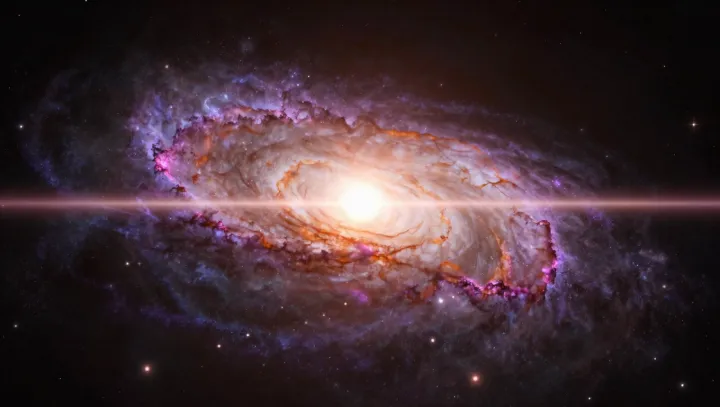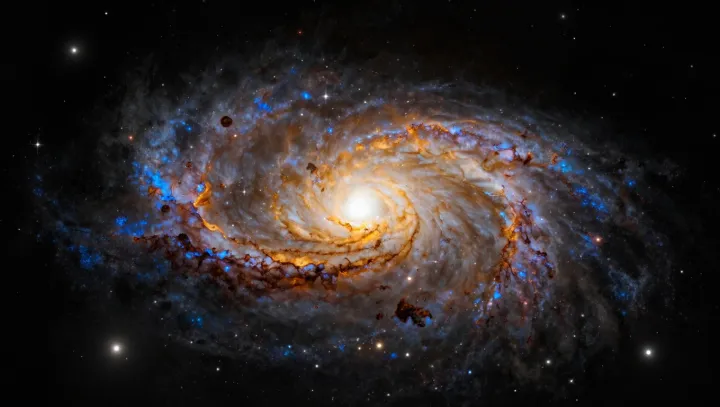
A spiral galaxy should be a mess. Stars at the outer edge orbit so fast that visible gravity alone should lose the argument and let them escape. Instead, the disk holds together in a clean, almost arrogant spiral, as if some hidden accountant keeps the gravitational books balanced.
Astronomers argue this order is not elegance but evidence. When they plot galactic rotation curves, the orbital speed of stars stays almost flat with radius, defying the drop predicted by Newtonian gravity applied only to luminous mass. Gas clouds, star clusters and even gravitational lensing all report the same discrepancy: there is far more gravitating stuff than photons reveal.
The unsettling part is how empty the system remains. On average, stellar material occupies a tiny fraction of the galactic volume, with vast regions of near-vacuum separating stars and nebulae, yet the overall mass profile behaves as though an extended dark matter halo wraps the disk. That halo, inferred through Poisson’s equation and N-body simulations, supplies the extra gravity that keeps those fast outer orbits bound.
Skeptics counter with modified Newtonian dynamics and other tweaks to the law of gravity, insisting the missing mass is really missing physics. Supporters of dark matter respond that a single invisible component explains not only spiral rotation but also galaxy clusters and the fine structure of the cosmic microwave background. Between an empty-looking disk and its locked-in spiral pattern, the invisible option still wins the bet.